
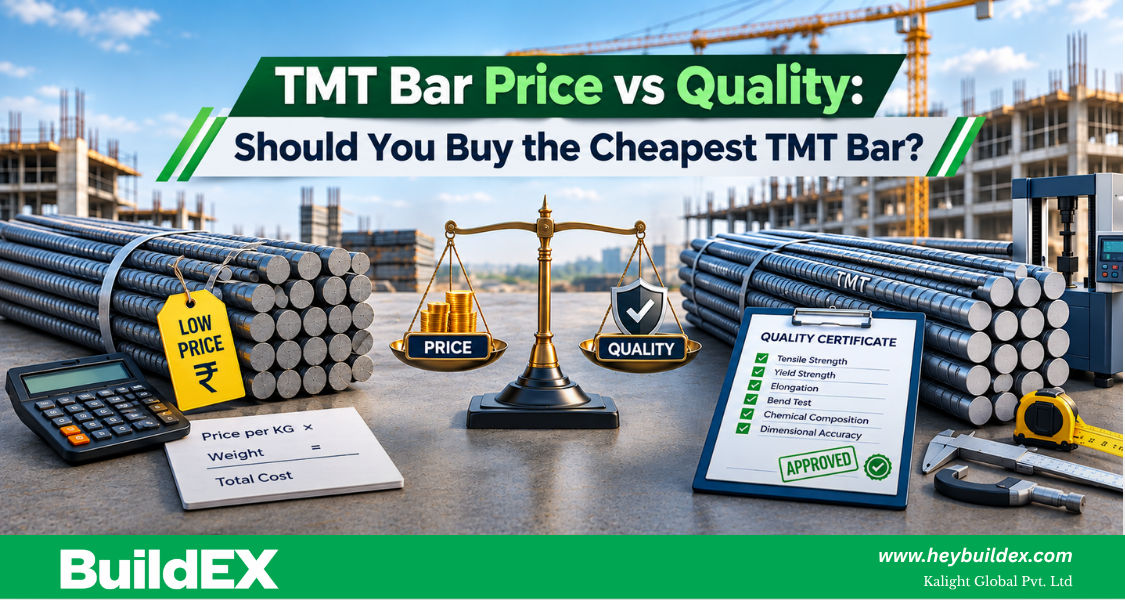
Quick Answer
The cheapest TMT bar is not automatically the best choice, because price alone does not establish quality. Before deciding, buyers should verify the required grade, the applicable BIS specification, mechanical properties such as yield and tensile strength, dimensions, unit weight, test documentation, corrosion-resistance needs, and the supplier's overall reliability.
Picture a common site situation: two steel suppliers quote a TMT bar price for the same project, and one figure comes in noticeably lower than the other. It is tempting to sign off on the cheaper quotation straight away. But since TMT bars form the structural reinforcement inside every column, beam and slab, this is not a decision to make on price alone.
Cheap price does not automatically mean poor quality, and higher price does not automatically mean better quality. A lower quotation can come from a genuine cost advantage, or it can signal a shortfall somewhere in grade, testing or consistency. The only way to know is to evaluate value, not just the number on the quotation. This guide walks through how TMT bar price and quality relate to each other, and how to compare suppliers with confidence.
TMT Bar Price vs Quality: What Is the Difference?
Price and quality describe two different things, and confusing them leads to poor purchasing decisions.
Price is driven by commercial factors:
- Cost per kg or per tonne
- Brand premium and grade-related pricing
- Location, transportation and taxes
- Order quantity and prevailing market conditions
Quality is a technical measure of the steel itself:
- Grade, yield strength and tensile strength
- Elongation, ductility and bend/rebend performance
- Chemical composition and dimensional accuracy
- Rib pattern, weight accuracy and manufacturing consistency
- Conformance to the applicable standard and certification
Price and quality are related — better-controlled manufacturing usually costs more — but they are not interchangeable. A buyer needs both figures side by side, not one in place of the other.
Why Is One TMT Bar Cheaper Than Another?
A lower TMT bar price does not automatically mean inferior steel. Several legitimate factors can explain the gap, including steel grade, brand positioning, and whether the bar comes from a primary or secondary production route. Manufacturing process, raw material cost, order quantity, location and transportation, dealer margins, payment terms, and testing or certification requirements all influence the final number as well.
The right response to a low quotation is not automatic rejection — it is investigation. Ask what is driving the difference, and confirm it against the required specification before deciding.
TMT Bar Price per Kg vs Actual Buying Cost
Comparing suppliers on TMT bar price per kg alone is one of the most common buying mistakes. The quoted rate is only the starting point of the real cost.
Basic Material Cost = TMT Bar Price per Kg × Quantity Purchased
The amount actually payable also depends on GST, transportation, loading and unloading, handling, delivery charges and any other supplier-specific charges.
Illustrative example (figures are for explanation only, not current market rates):
- Supplier A: ₹X/kg × 5,000 kg = base cost, plus transport and taxes
- Supplier B: ₹Y/kg × 5,000 kg = base cost, plus transport and taxes
If Supplier A quotes a lower rate per kg but adds higher freight, handling or delivery charges, the final landed cost can end up close to — or even higher than — Supplier B. Always ask for the all-inclusive figure before comparing.
TMT Bar Quality: What Should You Actually Check?
A structured TMT bar quality check protects the project far more than chasing the lowest quotation. Review the following before accepting delivery:
- Correct grade for the project and applicable BIS standard
- Manufacturer or supplier documentation, including test certificate
- Heat number or traceability, where applicable
- Yield strength, tensile strength and elongation values
- Bend test and rebend performance
- Chemical composition
- Diameter and dimensional tolerance
- Unit weight against the standard specification
- Surface and rib condition, with no visible defects
- Corrosion or rusting condition, and batch-to-batch consistency
BIS documentation identifies IS 1786:2008 as the specification for high-strength deformed steel bars and wires used for concrete reinforcement, and it is a useful reference point when discussing applicable standards with a supplier.
TMT Bar Strength vs Price
A higher price does not automatically mean a higher-strength bar, and buyers should not assume the two move together. Grade selection — Fe 500, Fe 500D, Fe 550, Fe 550D or Fe 600 — should follow the structural engineer's design and project specification, not simply the grade with the biggest number on the invoice.
Strength is also only one part of overall quality. Ductility, bendability, weldability where relevant, corrosion resistance, dimensional consistency and manufacturing quality all contribute to how a TMT bar performs on site. A bar can meet the required strength and still fall short on consistency or finish, so the full technical picture matters more than a single figure.
Is the Cheapest TMT Bar Safe for House Construction?
The honest answer sits in the middle. A lower-priced TMT bar can be perfectly acceptable when the required specifications are met, the grade is correct, quality documentation is available, mechanical properties and dimensions check out, and the supplier is reliable.
On the other hand, price alone should not decide the purchase when documentation is missing, the grade is unclear, test results are unavailable, weight looks inconsistent, bars show visible defects, the supplier cannot establish traceability, or the material does not match the project specification. In those situations, the low price is a warning sign to investigate, not a reason to proceed.
How to Find the Best Quality TMT Bars at a Reasonable Price
- Compare quotations from at least two to three suppliers
- Confirm the required grade before requesting quotes
- Check quality documentation and test certificates
- Compare the final landed cost, not just the price per kg
- Verify the actual quantity supplied against the invoice
- Check delivery terms and lead time
- Ask for testing documentation upfront
- Buy according to project requirements, not brand assumptions
- Treat unusually low quotations as something to verify, not accept blindly
- Work with a reliable, established steel supplier
TMT Bar Price Today — Why Does It Change?
TMT bar price today moves with several inputs: iron ore and scrap prices, energy and production costs, domestic demand and infrastructure activity, supply and inventory levels, freight, regional market conditions, supplier margins and general market volatility.
Current published market pages show that TMT pricing varies by city, grade and supplier, which is why a single India-wide figure should never be treated as the rate for every buyer. Always check the price for your specific city, grade, supplier type, and date, and confirm whether taxes are included before comparing it with another quotation.
Primary vs Secondary TMT Steel — Does Price Always Tell the Difference?
Primary steel is produced by large, integrated manufacturers, while secondary steel typically comes from smaller re-rolling units. Market pricing between the two can differ for genuine commercial reasons, not purely because of quality. Rather than assuming all secondary steel is inferior or all branded steel is automatically superior, buyers should focus on applicable specifications, verified quality and clear documentation. Source and traceability matter more than the primary-or-secondary label on its own.
How Much Can You Save by Buying the Cheapest TMT Bar?
In the short term, a lower price per kg reduces the initial material quotation and can look like a clear saving. But the long-term view should also weigh compliance with project specifications, material consistency, the risk of rework, procurement reliability, delivery performance, quality assurance and the possibility of project delays.
This does not mean cheaper steel will definitely cause structural problems — many lower-priced quotations are perfectly sound. It simply means the decision should be based on verified value across the project, not the smallest number on a single invoice.
Best Buying Strategy for TMT Bars
- Identify project requirements.
- Confirm the required grade.
- Collect supplier quotations.
- Compare TMT steel price per kg.
- Check quality documentation.
- Calculate the final landed cost.
- Verify supplier credibility.
- Choose the best value, not automatically the lowest price.
The smartest TMT purchase is not necessarily the cheapest one — it is the one that delivers the required quality and specification at a competitive total cost.
TMT Bar Suppliers Across Andhra Pradesh
Steel pricing and availability vary by location, so it helps to check rates locally rather than relying on a single national figure. Buyers frequently look for TMT bar price in Visakhapatnam, TMT bar suppliers in Vizag, and TMT bars in Anandapuram and Kurmannapalem, while procurement teams elsewhere in Andhra Pradesh compare TMT bar price per kg in Vijayawada, along with rates in Amaravati, Guntur, Kakinada, Rajahmundry, Nellore and Tirupati. Buyers in Hyderabad follow the same principle — confirm current, location-specific pricing before finalising an order, whichever city you are sourcing in.
Buy TMT Bars from a Reliable Steel Supplier
Buildex supplies TMT bars and other construction materials to homeowners, contractors and bulk buyers who need dependable availability alongside competitive, quality-focused quotations. The focus is on matching stock to project requirements, coordinating delivery, and giving buyers a clear, itemised quotation so they can compare it properly against other suppliers rather than on price per kg alone.
Looking for TMT bars for your next construction project?
Compare your required grade, quantity, quality specifications and delivered cost before placing your order.
Quick Checklist: Before Buying TMT Bars, Check These 8 Things
- ☑ Required grade
- ☑ Applicable BIS specification
- ☑ Test certificate / documentation
- ☑ TMT bar strength (yield and tensile values)
- ☑ Diameter and unit weight
- ☑ Price per kg
- ☑ Transportation and applicable charges
- ☑ Supplier reliability
Frequently Asked Questions
1. Is the cheapest TMT bar always the best option?
No. The cheapest TMT bar is only a good option when it also meets the required grade, quality documentation and dimensional standards. Price should be one factor among several, not the deciding one.
2. How do I compare TMT bar price and quality?
Compare the final landed cost — price, transport, taxes and charges combined — against grade, test certification, dimensional accuracy and supplier reliability, rather than looking at the quoted price per kg alone.
3. What is a good TMT bar quality check before buying?
Check the grade, applicable BIS standard, test certificate, yield and tensile strength, bend/rebend performance, dimensional tolerance, unit weight and surface condition before accepting a batch.
4. Does a higher TMT bar price mean better quality?
Not necessarily. Price reflects brand, location, order size and market conditions as well as quality, so a higher price does not automatically guarantee better mechanical properties or consistency.
5. What factors affect TMT bar price per kg?
Grade, raw material and production costs, brand positioning, order quantity, location, transportation, taxes and prevailing market conditions all influence the price per kg.
6. How can I check TMT steel quality?
Ask for the test certificate covering yield strength, tensile strength, elongation and chemical composition, and verify dimensions, weight and surface finish against the applicable specification.
7. Which TMT grade is best for house construction?
There is no single 'best' grade for every project. The correct grade — commonly Fe 500 or Fe 500D for residential work — should be specified by the structural engineer based on the design requirements.