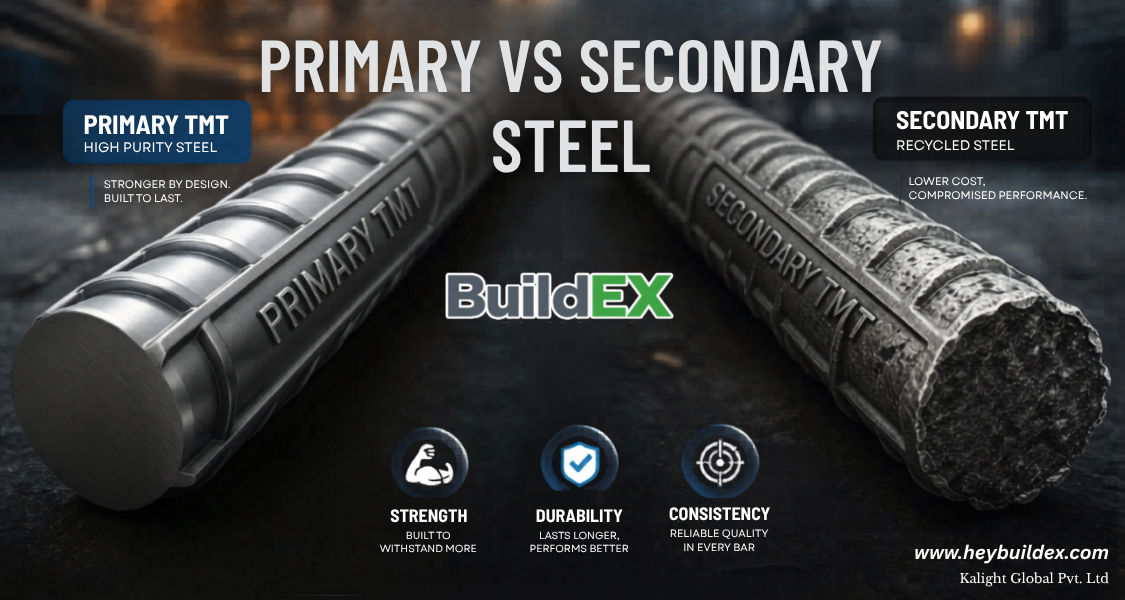
When specifying materials for your next project, understanding the difference between primary and secondary steel is critical — whether you're managing costs, meeting quality standards, or hitting sustainability targets. The terms primary steel and secondary steel refer to two fundamentally different production pathways, each with its own raw materials, energy profile, carbon footprint, and optimal use cases.
Primary steel is produced from virgin raw materials — iron ore, coal, and limestone — using a highly energy-intensive process that yields extremely pure, tightly controlled steel. Secondary steel, by contrast, is manufactured from recycled scrap metal using electric arc furnace (EAF) technology, offering a significantly lower carbon footprint and generally lower production costs.
For engineers, procurement teams, and project managers, choosing between the two isn't always straightforward. The right choice depends on your quality requirements, budget constraints, project scale, and environmental commitments. This guide breaks down everything you need to know — from how each type is made to a side-by-side comparison — so you can make a confident, informed decision.
Primary steel, also called virgin steel, is produced directly from raw natural materials rather than recycled inputs. It begins with iron ore extracted from the earth, which is then processed through a series of high-temperature industrial stages to produce pig iron and, ultimately, refined steel. Because the raw materials are sourced fresh at every production cycle, primary steel typically offers the highest levels of purity and compositional consistency of any steel type.
This consistency makes primary steel the preferred choice in applications where tight tolerances, predictable mechanical properties, and minimal impurities are non-negotiable — such as automotive body panels, aerospace structural components, and precision-engineered machinery.
Primary steel production relies on the Blast Furnace – Basic Oxygen Furnace (BF-BOF) process, which follows a well-established sequence:
This process is energy-intensive and heavily reliant on coal, resulting in approximately 2 tonnes of CO₂ emitted per tonne of steel produced.
Primary steel is favoured wherever material quality cannot be compromised. Key sectors include:
Secondary steel is produced from recycled scrap metal rather than virgin raw materials. It is manufactured using the Electric Arc Furnace (EAF) process, which melts down collected steel scrap using powerful electrical energy. Secondary steel accounts for a growing share of global production — and for good reason: it requires significantly less energy than BF-BOF steelmaking and produces a fraction of the carbon emissions.
While secondary steel may contain trace impurities inherited from the scrap feedstock, advances in EAF refining technology have dramatically improved quality consistency. For a wide range of structural and commercial applications, secondary steel performs identically to primary steel — at a lower cost and with a smaller environmental footprint.
The Electric Arc Furnace process is straightforward and efficient:
EAF production uses approximately 75% less energy than the BF-BOF route and emits as little as 0.4–0.6 tonnes of CO₂ per tonne of steel — making it the backbone of the green steel movement.
Secondary steel is the workhorse of the construction and general fabrication sectors:
The table below summarises the key differences across the most important evaluation criteria:
| Factor | Primary Steel | Secondary Steel |
|---|---|---|
| Raw Material | Iron ore, coal, limestone | Scrap metal |
| Production Process | Blast Furnace + BOF | Electric Arc Furnace (EAF) |
| Cost | Higher (energy & raw material intensive) | Generally lower (volatility with scrap prices) |
| Purity / Quality | Very high; tightly controlled | Variable; depends on scrap quality |
| CO₂ Emissions | ~2 tonnes CO₂ per tonne of steel | ~0.4–0.6 tonnes CO₂ per tonne |
| Energy Use | High (coal-dependent) | Lower (electricity-based) |
| Recyclability | Recyclable after use | Made from recycled scrap |
| Typical Applications | Automotive, aerospace, defense, precision mfg | Construction, rebar, general structural use |
Secondary steel is generally the more cost-effective option. Because EAF production uses recycled scrap rather than mined raw materials, it avoids the high costs associated with iron ore extraction, coking coal procurement, and large-scale blast furnace infrastructure. For buyers, this can translate to meaningful savings — particularly on high-volume structural projects.
That said, secondary steel pricing is sensitive to scrap metal market volatility. Global scrap availability, export restrictions, and logistics costs can cause price swings, so procurement teams should monitor scrap indices alongside conventional steel pricing when budgeting.
Primary steel offers superior compositional consistency because every production batch starts from clean, known raw materials. This matters in applications requiring exact tensile strength, yield strength, or impact resistance specifications — such as safety-critical automotive stampings or aerospace forgings.
Secondary steel, while historically associated with higher impurity levels (residual elements like copper, tin, or nickel from mixed scrap), has improved markedly due to better scrap sorting and EAF refining techniques. For most structural grades — including S275, S355, and standard rebar grades — secondary steel meets or exceeds the required mechanical property thresholds without compromise.
This is where secondary steel holds a decisive advantage. The BF-BOF route generates approximately 1.8–2.2 tonnes of CO₂ per tonne of crude steel. EAF-based secondary production emits roughly 0.4–0.6 tonnes per tonne — a reduction of over 70%.
As construction and manufacturing industries face tightening carbon regulations and net-zero commitments, secondary steel has become central to green procurement strategies. It contributes directly to BREEAM, LEED, and ISO 14001 sustainability credentials. The rise of "green steel" — combining EAF production with renewable electricity — promises to reduce that footprint even further in the coming decade.
Selecting the right steel type comes down to four key dimensions:
Understanding the distinction between primary and secondary steel is the first step — but sourcing the right material to spec, on time, and within budget requires the right supply partner. Buildex is a trusted steel supplier serving construction, infrastructure, and industrial projects across India. From TMT bars and structural sections to roofing sheets and binding wire, Buildex stocks top-grade steel from leading brands — with ISO-certified quality, 100% weighment transparency, and competitive pricing.
Not sure whether primary or secondary steel is right for your project?
Buildex is your trusted steel supplier — stocking TMT Bars, MS Channels, I Beams, MS Plates, Angles, Square Pipes, Roofing Sheets, and more from top brands including Tata, JSW, SAIL, Vizag Steel, and Jindal.
ISO-certified quality | 100% weighment transparency | Competitive pricing | On-time delivery
📞 +91 92814 46109 | ✉ support@heybuildex.com | 🌐 www.heybuildex.com