
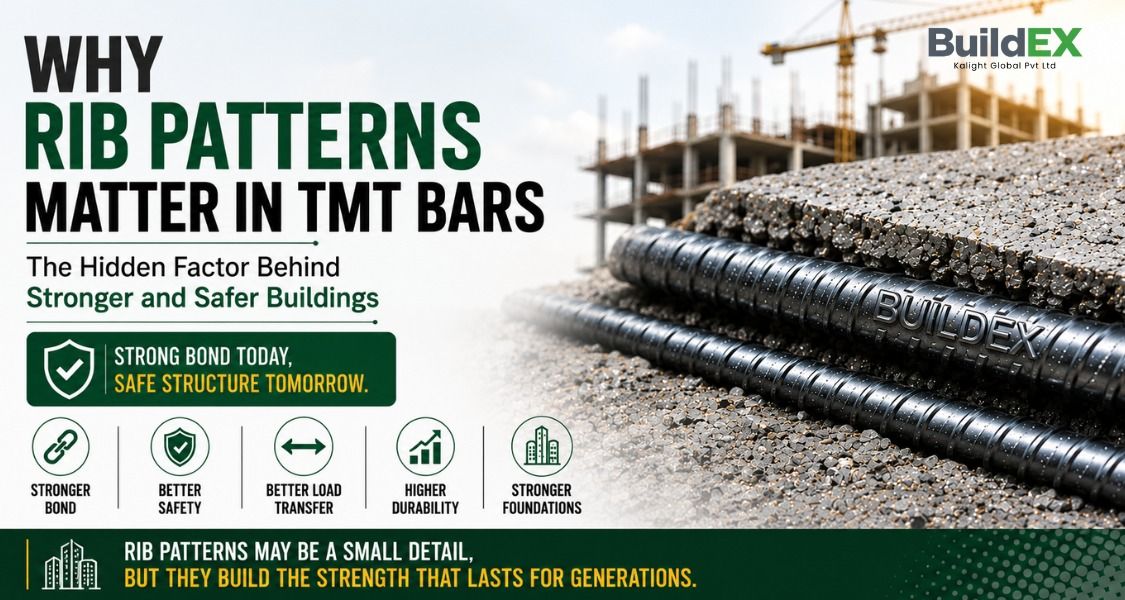
When people purchase TMT bars for construction, they often focus on the brand, price, grade Fe500, Fe550, or weight. However, there is another important feature that many people overlook—the rib patterns on the surface of TMT bars.
Those raised ridges or deformations on a TMT bar are not just for appearance. They play a critical role in helping steel and concrete work together as a single strong structure.
Whether you are building a house, commercial building, apartment, warehouse, or industrial project, understanding rib patterns can help you make better construction decisions and ensure long-term structural safety.
What Are Rib Patterns in TMT Bars?
Rib patterns are the raised projections found on the surface of TMT bars.
Unlike plain steel bars, TMT bars have specially designed ribs that improve their grip within concrete. These ribs create a mechanical bond between steel and concrete, reducing the chances of slippage under load.
Think of it like the tread pattern on a vehicle tire.
A smooth tire has less grip on the road, while a tire with deep tread patterns provides better traction and control. Similarly, ribbed TMT bars provide stronger grip inside concrete than plain bars.
Key Purpose of Rib Patterns
- Improve bond strength with concrete
- Prevent steel slippage
- Increase load transfer efficiency
- Improve structural stability
- Enhance safety and durability
Why Bond Strength Matters
Concrete is strong in compression but weak in tension.
Steel reinforcement is added to handle tensile forces and strengthen the structure.
For a building to perform properly, steel and concrete must act together as one unit. This is only possible when there is a strong bond between them.
If the bond is weak:
- ❌ Steel may slip inside concrete
- ❌ Cracks may develop
- ❌ Load transfer becomes inefficient
- ❌ Structural strength decreases
- ❌ Long-term durability is affected
Strong bond strength ensures that the load is effectively transferred between concrete and steel.
How Rib Patterns Improve Bond Strength
1. Increased Surface Area
The ribbed design increases the contact area between steel and concrete.
More contact area means stronger adhesion and better load distribution.
2. Mechanical Interlocking
The ribs lock themselves into the surrounding concrete.
This mechanical interlock creates resistance against movement and prevents pull-out under heavy loads.
3. Better Stress Transfer
Buildings are constantly subjected to various loads, including:
- Dead loads
- Live loads
- Wind loads
- Seismic forces
Ribbed TMT bars help transfer these stresses efficiently between steel and concrete.
4. Reduced Slippage
One of the biggest advantages of rib patterns is the reduction of slippage.
When steel remains firmly anchored inside concrete, structural performance improves significantly.
Ribbed TMT Bars vs Plain Bars
| Feature | Ribbed TMT Bars | Plain Steel Bars |
|---|---|---|
| Bond Strength | High | Low |
| Grip with Concrete | Excellent | Limited |
| Slippage Risk | Very Low | Higher |
| Structural Performance | Superior | Lower |
| Safety | Higher | Lower |
| Durability | Better | Moderate |
Modern construction projects almost exclusively use ribbed TMT bars because of their superior performance.
How Rib Patterns Affect Structural Safety
Many people underestimate the role of rib patterns in structural safety.
However, the quality of the bond between steel and concrete directly influences how a building performs throughout its life.
Better Crack Resistance
A stronger bond reduces stress concentration and helps control cracking in concrete.
Improved Earthquake Performance
During seismic activity, forces continuously act on the structure.
Ribbed TMT bars help maintain the integrity of the steel-concrete bond, improving structural resilience.
Higher Load Carrying Capacity
When steel and concrete work together efficiently, the structure can safely withstand higher loads.
Longer Building Life
Strong bonding reduces maintenance requirements and increases the lifespan of the structure.
Real-Life Example
Imagine two buildings constructed using the same concrete grade and same steel quantity.
Building A
Uses high-quality ribbed TMT bars.
Building B
Uses plain or poorly designed reinforcement bars.
Over time:
- Building A develops fewer cracks.
- Building A shows better load performance.
- Building A requires less maintenance.
- Building A remains structurally stronger.
The difference comes largely from the quality of bonding between steel and concrete.
This demonstrates why rib patterns matter much more than most people realize.
What to Look for When Buying TMT Bars
Before purchasing TMT bars, consider the following:
Check for Proper Rib Patterns
Ensure the ribs are clearly defined and uniformly distributed.
Buy Certified Steel
Always choose TMT bars that comply with BIS standards.
Purchase from Reputed Brands
Quality manufacturers maintain consistent rib geometry and manufacturing standards.
Verify Product Specifications
Check:
- Grade (Fe500, Fe550, etc.)
- Test certificates
- Manufacturer details
- Quality markings
Avoid Unverified Sources
Low-quality steel may have inconsistent rib patterns, affecting bond performance and structural safety.
Best Practices at Construction Sites
Even the best TMT bars require proper handling.
Follow These Practices
- ✔ Use approved structural designs
- ✔ Maintain proper concrete cover
- ✔ Ensure proper compaction of concrete
- ✔ Avoid excessive rust on reinforcement
- ✔ Follow engineer specifications
- ✔ Use quality concrete and workmanship
These practices help maximize the benefits of ribbed TMT bars.
Conclusion
Rib patterns may appear to be a small detail, but they have a major impact on construction quality.
They improve the bond between steel and concrete, reduce slippage, enhance load transfer, and contribute significantly to structural safety and durability.
The next time you inspect a TMT bar, remember that those ribs are not just a design feature—they are one of the key reasons modern buildings remain strong, safe, and long-lasting.
Choosing quality ribbed TMT bars is not just about buying steel. It is about investing in the strength and future of your structure.
Frequently Asked Questions (FAQs)
1. What are rib patterns in TMT bars?
Rib patterns are raised deformations on the surface of TMT bars that improve bonding with concrete and prevent slippage.
2. Why are rib patterns important?
They increase bond strength, improve load transfer, enhance safety, and contribute to the durability of structures.
3. Do ribbed TMT bars perform better than plain bars?
Yes. Ribbed TMT bars provide stronger grip, better bonding, and higher structural performance compared to plain bars.
4. Can rib patterns affect earthquake resistance?
Yes. Strong bonding between steel and concrete improves structural stability during seismic activity.
5. How can I identify quality ribbed TMT bars?
Look for uniform rib patterns, BIS certification, manufacturer markings, and purchase from reputed brands.
6. Do all TMT bars have rib patterns?
Most modern TMT bars have rib patterns because they are essential for reinforced concrete construction.
7. Can poor rib patterns affect building safety?
Yes. Poor bonding can lead to slippage, cracks, reduced load transfer, and lower structural reliability.
8. Are rib patterns more important than steel grade?
Both are important. Steel grade determines strength, while rib patterns ensure effective bonding with concrete. Together they contribute to overall structural performance.