
Introduction
If there is one metal that quietly powers the modern world, it is copper. From the wiring inside your home to the motors driving electric vehicles, copper is everywhere — and for good reason. It is one of the oldest metals known to humanity and still one of the most important industrial metals today.
Copper plays a critical role in electrical infrastructure, construction, renewable energy, telecommunications, and manufacturing. As India and other developing nations accelerate industrial growth and smart infrastructure projects, the demand for copper continues to rise sharply across global markets.
This guide explains what copper is, explores its key properties, highlights its most important uses, and covers the types of copper products driving industry forward.
What Is Copper?
Copper (Cu) has been in use for more than 10,000 years, making it one of the first metals ever used by humans. Ancient civilisations used it for tools, coins, and ornaments. Today, it remains irreplaceable in modern technology and industrial applications.
It belongs to the group of non-ferrous metals — metals that do not contain significant amounts of iron. Copper is naturally found in the earth's crust and is extracted through open-pit or underground mining, primarily in countries like Chile, Peru, the Democratic Republic of Congo, and India.
With a global annual production of over 21 million metric tonnes, copper is one of the most traded industrial commodities in the world.
Properties of Copper
The reason copper is used across so many industries comes down to its unique combination of physical and chemical properties. Here is what makes it stand apart from other metals:
| Property | What It Means | Industrial Benefit |
|---|---|---|
| Electrical Conductivity | Second only to silver in conducting electricity | Efficient, low-loss power transmission |
| Thermal Conductivity | Transfers heat rapidly and efficiently | Used in heat exchangers and radiators |
| Corrosion Resistance | Forms a protective patina over time | Long service life with minimal maintenance |
| Malleability | Can be shaped, bent, and formed easily | Easy fabrication for complex parts |
| Ductility | Can be drawn into fine wires without breaking | Essential for wire and cable manufacturing |
| Recyclability | 100% recyclable without loss of quality | Supports sustainable and circular manufacturing |
| Durability | Withstands heavy use and harsh environments | Reliable performance in demanding applications |
Why Is Copper Used Everywhere?
The answer is simple: no other affordable metal delivers the same combination of performance, durability, and sustainability. While silver is a slightly better conductor, it is far too expensive for industrial-scale use. Aluminium is cheaper but inferior in conductivity and strength. Copper hits the sweet spot between performance and cost.
Here are the top reasons industries around the world rely on copper:
- Superior electrical and thermal conductivity
- Naturally antimicrobial surface — kills bacteria on contact
- Highly recyclable — about 80% of all copper ever mined is still in use today
- Easy to join, solder, and fabricate
- Excellent strength-to-weight ratio
- Long service lifespan even in harsh conditions
Most Common Uses of Copper
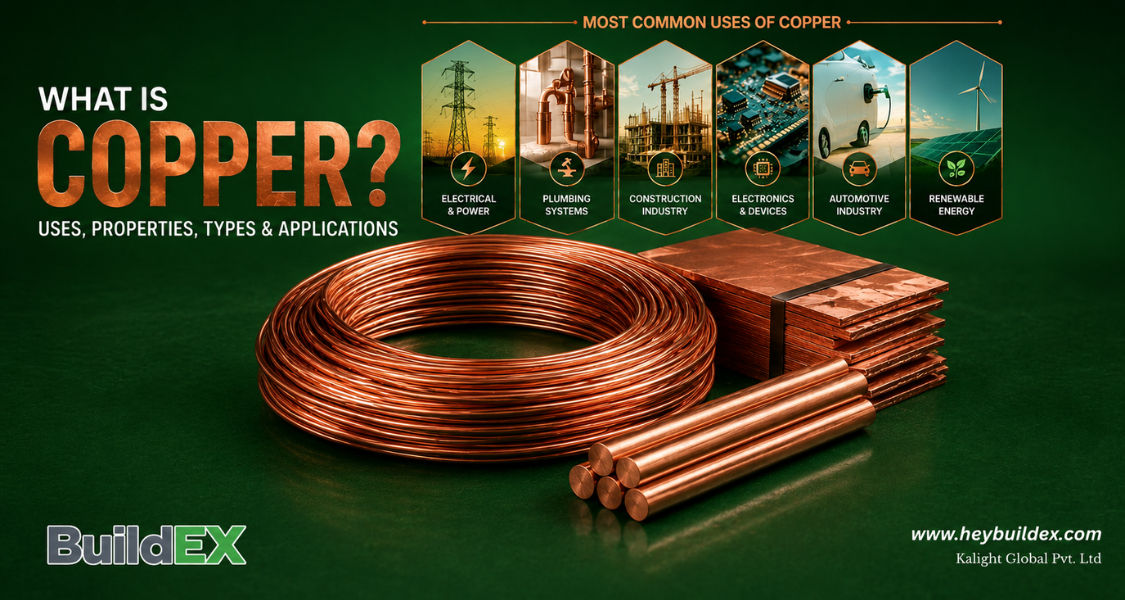
Copper is one of the most versatile industrial metals on earth. Its applications span nearly every major industry. Here is a detailed look at where copper is most widely used:
Copper in the Electrical Industry
This is by far the largest use of copper globally. Copper is the backbone of the entire electrical infrastructure — from power generation to end-user delivery.
- Power transmission cables and overhead lines
- Electrical wiring in homes, offices, and factories
- Transformers and switchgear
- Electric motors and generators
- Bus bars for high-current distribution
Copper in Construction
In India and globally, construction is one of the fastest-growing consumers of copper. Its corrosion resistance and long life make it perfect for building applications.
- Plumbing pipes and fittings — copper resists corrosion and is safe for drinking water
- Roofing sheets and cladding for premium buildings
- HVAC (heating, ventilation, and air conditioning) systems
- Architectural decorative elements
Copper in Renewable Energy
The global shift to clean energy is supercharging demand for copper. Every renewable energy system — from solar panels to wind turbines — requires significant amounts of copper.
- Solar photovoltaic (PV) panels and inverters
- Wind turbine generators and power cables
- Battery energy storage systems (BESS)
- Electric vehicle (EV) charging infrastructure
Copper in Electronics and Telecommunications
- Printed circuit boards (PCBs) in computers, smartphones, and tablets
- Data cables and network infrastructure
- Semiconductors and microchips
- Antennas and signal transmission equipment
Copper in Transportation
- Electric vehicles — an EV uses 3 to 4 times more copper than a conventional car
- Railway electrification and signalling systems
- Automotive wiring harnesses and connectors
- Aircraft and marine electrical systems
Types of Copper Products
Copper is processed into a variety of refined forms to suit different industrial and manufacturing needs. The two most fundamental copper products are copper wire rods and copper cathodes.
Copper Wire Rods
Copper wire rods are one of the most important downstream copper products. They are produced by continuously casting and rolling refined copper into long, coiled rods, typically 8mm in diameter. Wire rods are the primary raw material for:
- Electrical cable and wire manufacturing
- Winding wires for motors and transformers
- Flexible and building wires
- Power and communication cables
The quality and purity of copper wire rods directly impacts the conductivity and performance of finished electrical products. High-purity wire rods (99.9% Cu) ensure minimal electrical resistance and maximum efficiency.
Copper Cathodes
Copper cathodes are flat, refined copper plates that represent one of the purest forms of commercially available copper, typically achieving a purity of 99.99%. They are the fundamental raw material for producing all other copper products.
- Copper wire rods
- Copper tubes and pipes
- Copper strips, sheets, and foils
- Copper alloys (brass, bronze)
Industrial Supply
BUILDEX supply premium-quality Copper Wire Rods and Copper Cathodes for industrial, electrical, and manufacturing applications — meeting international quality and purity standards for reliable performance across all industry sectors.
How Is Copper Manufactured?
Understanding how copper is manufactured helps explain why it is such a pure, high-performance material. Here is the step-by-step process:
- Mining — Copper ore is extracted from open-pit or underground mines. The ore typically contains 0.5% to 2% copper.
- Crushing and Concentration — The ore is crushed and ground, then processed using froth flotation to produce a copper concentrate (25–35% copper).
- Smelting — The concentrate is smelted in a furnace to produce blister copper (98–99% purity), releasing sulphur dioxide as a byproduct.
- Fire Refining — Molten blister copper is refined in an anode furnace to remove impurities and cast into large anode plates.
- Electrolytic Purification — Anode plates are placed in an electrolytic solution. Pure copper (99.99%) deposits onto starter sheets, forming copper cathodes.
- Casting into Products — Cathodes are melted and continuously cast into wire rods, billets, or tubes for downstream manufacturing.
Industries That Use Copper the Most
| Industry | Global Share | Key Application |
|---|---|---|
| Electrical & Electronics | ~65% | Wiring, cables, motors, PCBs |
| Construction | ~25% | Plumbing, HVAC, roofing |
| Transportation | ~7% | EVs, railways, aerospace |
| Industrial Machinery | ~3% | Heat exchangers, pumps, valves |
Advantages of Copper
- Excellent electrical conductivity — ideal for all power transmission applications
- Outstanding thermal conductivity — used in heat management systems
- Corrosion resistant — naturally forms a protective patina, extending its lifespan
- Highly durable — performs reliably even under mechanical stress and harsh conditions
- 100% recyclable — copper loses none of its quality through the recycling process
- Easy to fabricate — can be drawn, rolled, extruded, and formed into any shape
- Antimicrobial properties — copper surfaces actively kill bacteria and viruses
- Long service life — copper installations routinely last 50+ years
The Future of the Copper Industry
The outlook for copper has never been stronger. Several powerful global trends are converging to drive sustained demand growth over the coming decades.
Electric Vehicles (EVs)
An electric vehicle uses approximately 83 kg of copper — roughly four times more than a conventional combustion-engine car. With global EV sales projected to grow exponentially, the automotive sector alone will add millions of tonnes to annual copper demand. India's ambitious EV mission under FAME II and Bharat Stage norms is already accelerating this shift.
Renewable Energy Expansion
Solar and wind energy systems are copper-intensive. A single wind turbine can contain up to 4 tonnes of copper. As India targets 500 GW of renewable energy capacity by 2030, demand for copper wire, cables, and transformers will surge significantly.
Smart Cities and Digital Infrastructure
India's Smart Cities Mission, data centre expansion, and 5G rollout all require extensive copper cabling and electrical infrastructure. Digital India initiatives are creating new high-volume demand streams for copper products.
Green Energy Transition
The global shift away from fossil fuels is sometimes described as a 'copper supercycle.' International energy agencies estimate the world will need 50% more copper by 2035 to meet clean energy targets. Copper is, quite literally, the metal of the energy transition.
Conclusion
Copper remains one of the most essential industrial metals due to its exceptional conductivity, durability, corrosion resistance, and versatility. As industries continue to expand and renewable energy adoption increases, copper will remain a critical material for modern infrastructure and technological innovation.
Whether you are sourcing Copper Wire Rods for cable manufacturing or Copper Cathodes as a raw material for downstream processing, partnering with a reliable, quality-assured supplier ensures consistent performance for all your industrial and electrical applications.
Frequently Asked Questions (FAQ)
The following answers are optimised for Google Featured Snippets, voice search, and AI-powered search engines.
1. What is copper and its uses?
Copper is a reddish-brown non-ferrous metal (symbol: Cu) known for excellent electrical and thermal conductivity. It is used in electrical wiring, power cables, construction plumbing, electronics, electric vehicles, renewable energy systems, and industrial machinery across the world.
2. Why is copper so valuable?
Copper is valuable because it combines the best electrical conductivity, thermal efficiency, corrosion resistance, and recyclability in a single affordable material. No other metal matches this performance-cost combination, making it irreplaceable in electrical, construction, and energy industries.
3. What are the main properties of copper?
The main properties of copper are: excellent electrical conductivity (second only to silver), high thermal conductivity, strong corrosion resistance, natural malleability and ductility, 100% recyclability, durability, and natural antimicrobial surface properties.
4. Why is copper used in electrical wiring?
Copper is used in electrical wiring because it has the highest practical electrical conductivity of any affordable metal. It carries current efficiently with minimal energy loss, is flexible and easy to work with, has a long service lifespan, and is safer than aluminium for household and industrial wiring.
5. Is copper stronger than aluminium?
Copper is denser and has higher tensile strength than aluminium. While aluminium is lighter, copper is about 67% more conductive electrically, making it the preferred choice for applications where conductivity, strength, and durability are critical over weight reduction.
6. What industries use copper the most?
The electrical and electronics industry uses the most copper globally (around 65% of total consumption), followed by construction (25%), transportation (7%), and industrial machinery (3%). India's rapidly expanding power and EV sectors are significant contributors to this demand.
7. How is copper manufactured?
Copper is manufactured through six stages: ore mining, crushing and flotation to produce concentrate, smelting into blister copper, fire refining into anode plates, electrolytic purification to produce 99.99% pure copper cathodes, and finally casting into wire rods, tubes, or sheets.
8. Is copper corrosion resistant?
Yes, copper is highly corrosion resistant. When exposed to air and moisture, it naturally forms a thin protective oxide layer (green patina) that prevents further corrosion. This is why copper plumbing and roofing installations can last well over 50 years with minimal maintenance.
9. What are the advantages of copper?
The key advantages of copper are its excellent electrical and thermal conductivity, strong corrosion resistance, high ductility and malleability, 100% recyclability without quality loss, long service life, and natural antimicrobial surface properties that are unmatched by other common metals.