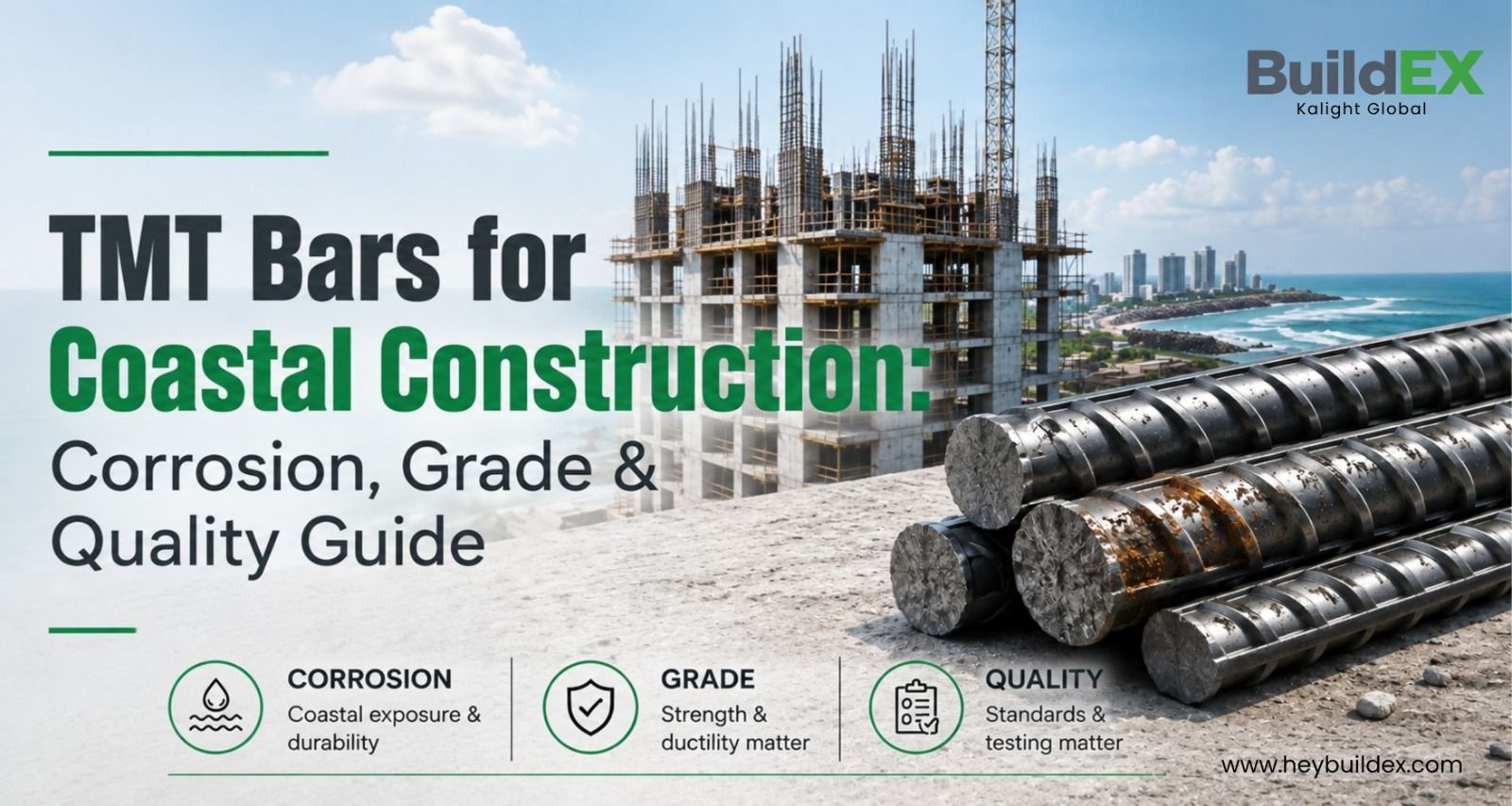
Coastal construction faces a challenge that inland projects rarely deal with: salt-laden air and constant moisture that can quietly work against reinforcement steel over time. Choosing quality TMT bars is an important part of building a durable structure near the coast, but it isn't the only part. Concrete quality, cover thickness, and site practices all play a role in how well a structure holds up over the years.
Coastal projects typically use corrosion-resistant TMT bars such as Fe 500D or Fe 550D, produced under recognized standards with consistent quality control. That said, the right grade for any project should always be confirmed by a structural engineer based on the specific design requirements.
Areas close to the sea experience higher humidity and salt-laden air almost year-round. Over time, tiny salt particles settle on exposed concrete surfaces, and moisture helps carry chlorides into the concrete through its natural pore structure.
This is what's known as chloride-induced corrosion. In plain terms, salt and moisture slowly find their way through the concrete toward the embedded steel. Once chlorides build up enough around the reinforcement, they weaken the steel's natural protective layer, and rusting can begin. This is a gradual process, which is exactly why it's easy to overlook until visible damage appears.
The process generally unfolds in a simple sequence:
Moisture and chlorides penetrate the concrete → they reach the embedded reinforcement → the steel's protective layer breaks down → corrosion begins → rust forms and expands → the surrounding concrete comes under pressure and may crack.
For homeowners and site teams, this explains why problems like hairline cracks or rust staining on a coastal building often trace back to a slow process that started well below the surface. Paying attention to material quality and construction practices early on — rather than after damage appears — makes a real difference to how long a structure lasts.
Corrosion resistant TMT bars are reinforcement bars manufactured with tighter control over chemical composition and processing, aimed at improving resistance to atmospheric and chloride-related corrosion compared to ordinary mild steel bars. This generally involves:
It's worth being upfront about one thing: no TMT bar is completely rust-proof. Corrosion-resistant TMT bars are designed to perform better under demanding conditions, but they don't work in isolation. Reinforcement steel and concrete function as a system — durability isn't determined by strength grade alone, and it isn't determined by the steel alone either.
Coastal projects most often involve a choice between the following grades:
| Grade | Strength | Ductility | Typical Use |
|---|---|---|---|
| Fe 500 | High yield strength | Moderate | General RCC construction |
| Fe 500D | High yield strength | High | Seismic zones, ductility-critical structures |
| Fe 550 | Higher yield strength | Moderate | Specific high-load design applications |
| Fe 550D | Higher yield strength | High | High-strength projects with ductility requirements |
Fe 500 refers to bars with a minimum yield strength of 500 MPa and is widely used across residential and commercial construction. Fe 500D carries the same strength rating but with the added "D" for high ductility — meaning the bar can absorb more deformation before it fails, which matters in seismic-prone areas. Fe 550 offers a step up in yield strength for specific structural needs, and Fe 550D combines that higher strength with high ductility.
Ductility matters because ductile bars bend and stretch under excessive stress rather than snapping suddenly, giving a structure more warning before serious failure. That said, a higher number isn't automatically the right answer — using a stronger grade than a design calls for adds cost without adding benefit. The best TMT grade for coastal construction should come from the structural engineer's calculations and applicable codes, not from grade alone.
When comparing options, it helps to run through a short checklist:
Corrosion resistance isn't just about the steel. Several factors work together:
Good TMT bars alone cannot guarantee long-term durability if the surrounding concrete is poorly mixed, under-cured, or cracked. Coastal durability is a system outcome — it depends on the reinforcement and the concrete working together, supported by careful site practices.
| Check | What to Do |
|---|---|
| Grade | Confirm the grade matches what's specified for the project. |
| Markings | Look for manufacturer identification and grade markings rolled onto the bar. |
| Diameter | Verify the bar size using a gauge or caliper. |
| Weight | Compare the delivered quantity against the purchase order. |
| Surface | Check for excessive corrosion, cracks, laminations, or other visible defects. |
| Documents | Request applicable test certificates and supporting product documentation. |
Coastal towns and cities such as Visakhapatnam, Kakinada, Nellore, and other parts of Andhra Pradesh's coastline continue to see steady construction activity. Their proximity to the sea means buildings here are consistently exposed to humid, salt-laden air in a way that inland sites usually aren't.
This makes it worth paying closer attention to verified steel quality, appropriate concrete mix design, adequate cover, and disciplined site practices from storage through curing. Specific corrosion rates and outcomes vary by microclimate and structure, so it isn't accurate to generalize numbers — but the broader principle holds across Andhra Pradesh's coastal belt and similar regions along India's East Coast: coastal exposure calls for a more careful, system-wide approach to durability.
Buildex supplies steel products for construction and industrial requirements, including TMT Bars, MS Beams, MS Channels, MS Angles, MS Pipes, MS Plates, HR Coils, and HR Sheets. For projects in Visakhapatnam, Vijayawada, Amaravati, Kakinada, and other parts of Andhra Pradesh, Buildex can help with product specifications, bulk order quantities, quotations, and delivery coordination — whether you're sourcing for a single coastal project or ongoing procurement needs.
The best TMT bars for coastal areas are generally corrosion-resistant grades such as Fe 500D or Fe 550D, produced to recognized standards with verified certification. The right choice for a specific project should always be confirmed against the structural engineer's specifications.
There isn't one universal answer — Fe 500D and Fe 550D are commonly chosen for their ductility and strength. The correct grade should be based on structural design requirements and applicable codes, not location alone.
Many TMT bars are manufactured to resist corrosion better than plain mild steel bars. However, no TMT bar is completely rust-proof, and how well it performs over time also depends on concrete quality, cover, and construction practices.
Salt-laden air and moisture carry chlorides that can gradually penetrate concrete. Once chlorides reach the embedded reinforcement, they weaken the steel's protective layer, which can lead to corrosion, rust expansion, and eventually concrete cracking.
Corrosion risk can be reduced through adequate concrete cover, a suitable water-cement ratio, thorough compaction, proper curing, crack control, and using quality-verified reinforcement. Prevention depends on the full construction system, not the steel bars alone.
Fe 500D is often used in coastal and seismic-prone projects because of its high ductility. Whether it's suitable for a specific project should be confirmed by a structural engineer based on the design requirements.
Fe 550D offers higher strength than Fe 500D, but "better" depends on what the structural design actually requires. Grade selection should follow engineering calculations rather than an assumption that higher strength is always the right choice.
No. Strength and corrosion resistance are separate properties. A higher-strength bar isn't automatically more resistant to chloride-related corrosion — that depends on chemical composition, manufacturing quality, and the surrounding concrete.
Check the grade marking, manufacturer identification, diameter, surface condition, and valid test certificates. Confirming batch traceability and buying from a reliable supplier further reduces the risk of receiving substandard material.
For coastal projects, verify the specified grade, certification, and supplier reliability, and confirm the chemical composition where it's specified. It also helps to check that the planned concrete specifications and construction practices align with the reinforcement's requirements.