
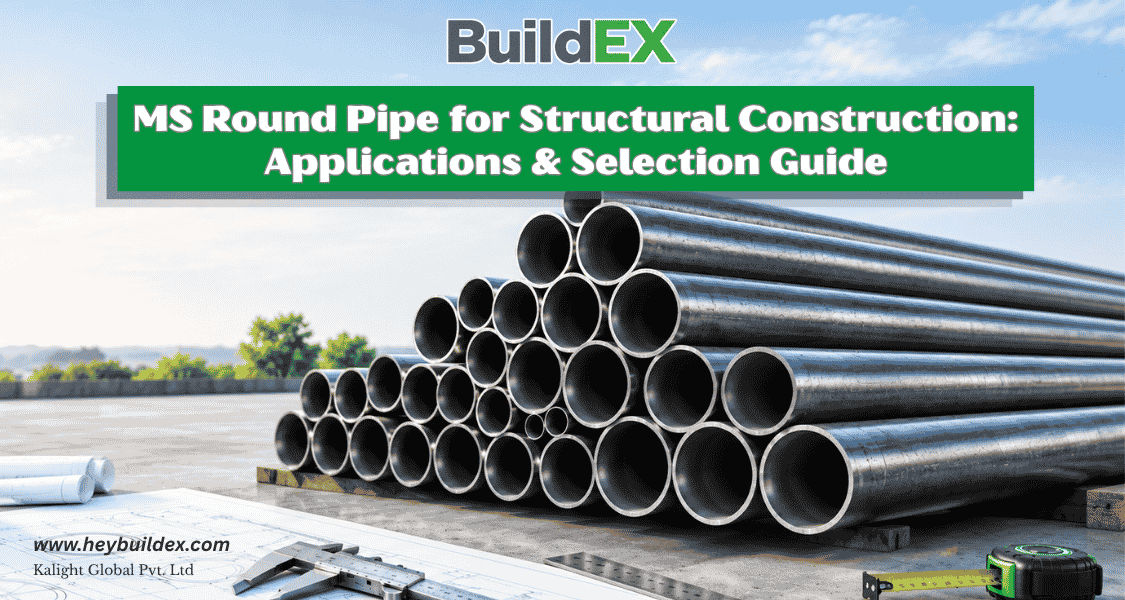
Walk through any warehouse, factory shed, or steel-framed building site and you will see round pipes carrying loads: holding up roofs, forming trusses, and supporting platforms. Mild steel (MS) round pipe is one of the most widely used sections in structural work, and for good reason.
This guide explains where MS round pipe for structural construction is used, why it works well, and how to choose the right pipe for your project. It is written for engineers, contractors, fabricators, and procurement teams.
What Is MS Round Pipe?
An MS round pipe, also called a mild steel round pipe, is a hollow cylindrical tube made from low-carbon steel. Mild steel is popular in construction because it is strong enough for most building loads, easy to cut and weld, and cost-effective compared with many other metals.
MS round pipes are usually made in two ways:
- ERW (Electric Resistance Welded): Steel strip is rolled into a round shape and the seam is welded. Widely used in general structural work.
- Seamless: Made without a weld seam, typically chosen where higher pressure or demanding load conditions apply.
For most building frameworks, ERW pipes are the common choice. Your structural designer should confirm what suits your project.
Why Use Round Pipe in Structural Construction?
Round hollow sections offer several practical advantages:
- Good strength-to-weight ratio: A hollow section carries load efficiently without the weight of a solid bar.
- Even strength in all directions: A round section resists bending and buckling equally about any axis, which is useful for columns and compression members.
- Easier handling and fabrication: Lighter members are easier to lift, transport, and install.
- Clean, simple design: Round pipes have no sharp corners, so they are easier to coat and to inspect for corrosion.
- Smooth surface for coating: A smooth surface can help paint or galvanizing coverage, depending on the application.
MS Round Pipe Applications in Structural Construction
The MS round pipe uses below are the most common in building and industrial work.
1. MS Round Pipe for Structural Framework
Pipes are often used to build the main skeleton of light to medium steel structures, including frames, trusses, and bracing systems. For MS round pipe for structural framework, designers favor round sections where members are mainly in compression or need to look neat and exposed.
2. MS Round Pipe for Structural Columns
Round pipes make good vertical members because their uniform shape resists buckling in every direction. For MS round pipe for structural columns, the wall thickness and diameter must be matched to the load and column height. This should be checked by a qualified structural engineer.
3. MS Round Pipe for Roof Support
Roof trusses, purlin supports, and canopy frames often use round pipe. MS round pipe for roof support is common in:
- Industrial sheds
- Parking shelters and canopies
- Open-sided workshops
- Light commercial roofing
4. MS Round Pipe for Structural Supports
Beyond the main frame, pipes serve as secondary supports such as:
- Bracing and tie members
- Equipment and pipe-rack supports
- Platform and mezzanine supports
- Handrails and guard rails
- Staircase frames
5. MS Round Pipe for Industrial Structures
In plants and factories, MS round pipe for industrial structures is used for conveyor supports, process platforms, utility racks, and machine frames. These settings often involve vibration, dust, or moisture, so the coating and wall thickness deserve extra attention.
6. MS Round Pipe for Warehouse Structures
For MS round pipe for warehouse structures, common uses include roof trusses, mezzanine floors, storage rack supports, and loading-bay canopies. Warehouses usually need wide, clear spans and repeatable modules, which suits standardized pipe sizes.
Quick Reference: Application Overview
| Application | Typical Role of the Pipe | Key Selection Focus |
|---|---|---|
| Structural framework | Main frame, trusses, bracing | Load capacity, weldability |
| Columns | Vertical load-bearing members | Diameter, wall thickness, height |
| Roof support | Trusses, purlin supports | Span, weight, corrosion protection |
| Industrial structures | Platforms, racks, equipment frames | Vibration, environment, coating |
| Warehouse structures | Roof frames, mezzanines, racks | Span, repeatability, cost |
| Handrails and supports | Secondary members | Finish, safety, appearance |
Round Pipe vs Other Structural Sections
Choosing the right shape matters. Here is a general comparison. Final choice depends on design requirements.
| Section | Strengths | Limitations |
|---|---|---|
| Round pipe | Equal strength in all directions, good for compression, smooth finish | Connections can need profiled cutting (coping) |
| Square/rectangular hollow section | Flat faces make bolting and connections easier | Corners can be weak points for coatings |
| I-beam / H-beam | Very efficient for bending loads | Heavier, and weaker about one axis |
| Angle / channel | Easy to connect, low cost | Less efficient in compression |
Many real structures mix these sections. For example, a truss might use round pipes for chords and angles for secondary bracing.
How to Choose MS Round Pipe for Structural Construction
If you are wondering how to choose MS round pipe for structural construction, follow this practical process.
Step 1: Understand the Load and Application
Start with what the pipe must carry. Consider:
- Dead load (weight of the structure itself)
- Live load (people, stock, equipment)
- Wind, snow, or seismic loads, depending on location
- Length of the span or height of the column
A structural engineer should calculate these. Never select pipe on a guess when safety is involved.
Step 2: Choose the Right Size
MS round pipe size selection for construction depends on three things:
- Outer diameter (OD): Affects stiffness and resistance to buckling.
- Wall thickness: Affects load capacity, welding quality, and corrosion allowance.
- Length: Longer unsupported lengths need larger diameters or thicker walls.
A larger diameter with a moderate wall is often more efficient against buckling than a smaller, thick-walled pipe. Check available sizes and tolerances with your supplier, as these vary by manufacturer and standard.
Step 3: Check the Standards
Using pipe that meets recognized standards helps ensure consistent quality. When reviewing MS round pipe standards for structural construction, commonly referenced standards in India include:
- IS 1161: Steel tubes for structural purposes
- IS 1239 (Part 1): Mild steel tubes, often used for general purposes
- IS 3589: Seamless or ERW steel pipes for larger diameters
- IS 806 and IS 800: Design and construction codes for steel in buildings
International projects may refer to standards such as ASTM or EN specifications. Please verify the latest applicable standard, grade, and revision with your structural consultant and supplier before ordering.
Step 4: Confirm the Material Grade and Test Certificates
Ask for the mill test certificate (MTC) or equivalent quality documents. These typically show chemical composition and mechanical properties. Confirm that the values match what your design requires.
Step 5: Consider the Environment and Protection
Where the structure will stand changes the specification:
- Indoor, dry areas: Basic primer and paint may be enough.
- Outdoor or humid areas: Consider galvanizing or a stronger coating system.
- Coastal or chemical environments: Needs a more robust protection plan and regular inspection.
Step 6: Plan for Fabrication and Joining
Think about how the pipes will be connected before you buy. Welded joints, flanged connections, and end plates each have different needs. Make sure the wall thickness suits your welding method, and that your fabricator can cut and fit the joints accurately.
Step 7: Check Supplier Reliability
A good supplier should offer consistent dimensions, clear documentation, proper packing, and dependable delivery. Inspect a sample lot for straightness, surface finish, and dimensional accuracy before placing bulk orders.
Common Mistakes to Avoid
- Choosing pipe by price alone without checking grade or standard
- Ignoring wall thickness tolerance
- Skipping test certificates
- Using light-duty pipe (for example, general-purpose tube) where structural-grade pipe is needed
- Underestimating corrosion protection for outdoor use
- Not coordinating pipe sizes with the connection design
Quick Selection Checklist
Before you order, confirm:
- Load and span calculations have been completed by a qualified engineer
- Outer diameter and wall thickness are finalized
- Applicable standard and grade are verified
- Test certificates are requested
- Coating or galvanizing is specified
- Joining method is planned
- Quantity, lengths, and delivery schedule are confirmed
Final Thoughts
MS round pipe for structural construction is a practical, versatile choice for frames, columns, roof supports, and industrial or warehouse structures. Getting the best result comes down to matching the right size, grade, and standard to your actual load and environment, and buying from a supplier who can document quality.
If you plan a structural project, share your drawings or requirements with your supplier and engineer early. It saves time, cost, and rework later.
Need MS round pipes for your next project? Contact BuildEX with your size, grade, and quantity requirements, and our team will help you with the right options and a quotation.
Frequently Asked Questions
What is MS round pipe used for in construction?
It is used for structural frames, columns, roof supports, trusses, bracing, platforms, handrails, and supports in industrial and warehouse buildings.
Is mild steel round pipe suitable for structural applications?
Yes, when the correct structural grade is used and the design is checked by a qualified engineer. Mild steel is strong, weldable, and widely available.
What is the difference between MS round pipe and structural round pipe?
“MS round pipe” describes the material (mild steel). Structural pipe refers to pipe made to meet structural standards. Always confirm the pipe meets the standard your project requires.
How do I choose the right size of MS round pipe?
Base it on load, span or height, outer diameter, and wall thickness. A structural engineer should confirm the final size.
Which standards apply to MS round pipe for structural use?
In India, IS 1161 is commonly referenced for structural tubes, along with IS 806 and IS 800 for design practice. Verify the latest revision for your project.
Is round pipe better than square pipe for columns?
Round pipe resists buckling equally in all directions, which suits columns. Square pipe offers flat faces that simplify connections. The better choice depends on the design.
Does MS round pipe need coating?
Usually yes, especially outdoors. Primer, paint, or galvanizing helps prevent rust. The right protection depends on the environment.
Can MS round pipe be used for warehouse structures?
Yes. It is commonly used for roof trusses, mezzanines, and supports, provided the sizes are designed for the expected loads.