
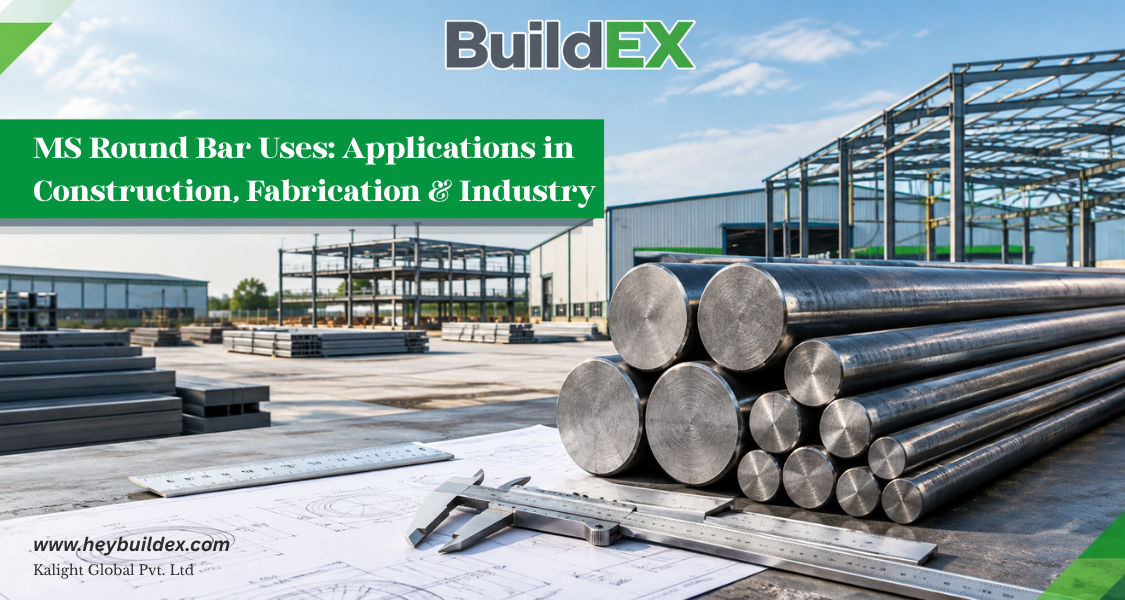
MS round bar uses range from gates, grills and railings to machined pins, shafts and industrial components. An MS round bar is a cylindrical mild steel section whose uniform circular cross-section can be cut, bent, drilled, turned and welded into many forms. MS round bars are versatile steel sections used wherever a cylindrical profile is required, across construction fabrication, machinery, supports and general engineering. Suitability, however, depends on diameter, material specification and intended use: a bar that works well for a balcony grill may be wrong for a loaded shaft, and ordinary round bars should never be treated as concrete reinforcement. This guide explains where they are used, why, and how Indian buyers can select them.
What Is an MS Round Bar?
An MS round bar is a solid steel section with a circular cross-section, made from mild steel (low-carbon steel) and supplied in defined diameters and lengths. Diameter is normally stated in millimetres, and the surface may be hot-rolled or finished, depending on the product. These mild steel round bars serve general fabrication and engineering work.
In day-to-day trade, “MS round bar”, “mild steel round bar” and “MS round rod” are often used interchangeably. Buyers should still verify the actual grade, standard and dimensions on the quotation rather than rely on the name alone.
Why Are MS Round Bars Widely Used?
Several practical characteristics explain their popularity in workshops and on project sites:
- Circular cross-section: a symmetrical profile suits turned, rotating and pin-type components, and gives a clean look in railings and grills.
- Range of diameters: small sections for decorative work and larger ones for machined parts are commonly available.
- Ease of cutting and drilling: fabrication shops can process the bar with standard workshop equipment.
- Machining and welding suitability: many grades can be turned and welded, but this depends on the specific grade and specification, so it should never be assumed for every bar.
- Versatility: one section can become a gate bar, a support member or a machined pin.
MS Round Bar Uses in Construction
On building sites, round bars appear mainly as fabricated steel rather than as part of the concrete structure. Typical MS round bar applications in construction are listed below.
Supports and Fabricated Components
Round sections are cut and welded into brackets, hangers, tie rods, anchor-type fixtures and utility supports. Where the component carries load, the section and grade should follow the engineer’s design and drawings.
Railings and Handrails
Stair railings, balcony handrails, guardrails and other fabricated safety structures commonly use round steel bar for balusters and infill, often with pipes or flats as top rails. Bar diameter and spacing should follow the design and applicable safety requirements.
Gates and Grills
Is MS round bar suitable for gates and grills? Yes, it is a common choice. Round bars can be bent into decorative patterns, welded into vertical or scroll bar layouts and finished with paint or galvanising. Typical uses include main gates, window and balcony security grills, boundary fencing and decorative fabrication. Diameter is chosen for strength, spacing and appearance.
General Construction Fabrication
Site and workshop teams also cut, drill, bend and weld round bars into project-specific items such as clamps, hooks, inserts and framing accessories.
Important: ordinary MS round bars are not a substitute for reinforcement bars. Reinforcement in concrete must meet the applicable reinforcement standard, such as IS 1786 for high-strength deformed bars, and the project specification.
MS Round Bar Uses in Fabrication
Fabrication shops value a standard cylindrical section because it is predictable to stock, cut and weld. Common outputs include gates, grills, railings, frames, brackets, supports, decorative steelwork, fabricated assemblies and industrial components.
A typical workflow runs from cutting to drilling, then turning or machining where required, then welding and assembly. Not every job needs every step: a grill may need only cutting, bending and welding, while a pin needs accurate turning. The process depends on the product specification and the application.
MS Round Bar for Machine Parts
Round bars are a common raw material for selected machined parts such as pins, bushes, shafts, spacers, rollers and coupling-type components. Machining from a round section wastes little material for cylindrical parts.
A general-purpose MS round bar is not automatically suitable for highly loaded or precision components. Selection depends on:
- Diameter and grade
- Mechanical properties
- Machining requirements and surface finish
- Tolerance
- Operating conditions
For critical parts, confirm with the design engineer whether mild steel is adequate or an alloy or medium-carbon grade is required.
MS Round Bar for Shafts and Pins
Can MS round bars be used for shafts and pins? In suitable applications, yes. The round profile is convenient for turning, so it is used for light-duty shafts, locating and hinge pins, axles, roller spindles, bush-related components and spacers.
Shaft material should be selected on load, torque, bending, wear, speed and environment, not on diameter alone. A thicker bar of unsuitable grade is not automatically a safer one. Heavily stressed or high-speed shafts need engineering calculation and often different materials or heat treatment.
MS Round Bar Applications in Machinery
Round bars are used as raw material or fabricated components in agricultural machinery, workshop equipment, industrial machines, material-handling equipment, fabrication machinery and general engineering components.
| Application | Typical Use |
|---|---|
| Machine parts | Machined components |
| Shafts | Rotating components where specification permits |
| Pins | Mechanical joining and location |
| Rollers | Cylindrical fabricated or machined components |
| Spacers | Dimensional spacing components |
| Supports | Fabricated support components |
Note: actual suitability depends on engineering specifications, loads and operating conditions.
MS Round Bar Applications Across Industries
- Construction: railings, gates, grills and fabricated components.
- Fabrication: frames, supports and decorative steelwork.
- Machinery: machined parts, shafts, pins and rollers.
- Agriculture: selected implement parts, shafts and fabricated components.
- Automotive and general engineering: only where the grade and mechanical properties suit the part; mild steel is not universally suitable for automotive or high-performance duty.
- Industrial maintenance: replacement pins, spacers, shafts and fabricated repair components.
Buyers sourcing MS round bars in Andhra Pradesh, Telangana or nearby industrial markets typically supply fabrication clusters, agricultural equipment makers and maintenance workshops, so diameter availability and delivery timelines matter.
How to Choose the Right MS Round Bar
- Diameter: depends on the design and application.
- Length: check standard supply length against required cut lengths to reduce wastage.
- Material grade: do not assume all MS round bars share identical mechanical properties.
- Application: gates, machinery and shafts need different specifications.
- Machining needs: consider machinability, diameter tolerance, surface condition and finish.
- Load and conditions: for shafts and machine parts, consider load, torque, bending, wear, speed and temperature or environment.
- Applicable standards: BIS lists IS 2062 as covering hot-rolled structural steel, with a current Part 1 (2025) listing for medium and high tensile grades, while IS 1732 is associated with dimensions of round and square bars for structural and general engineering purposes. Buyers should confirm the standard and edition their project requires. Not every MS round bar in the market automatically conforms to IS 2062.
MS Round Bar Size: What Should Buyers Check?
Confirm the diameter in mm, length, dimensional tolerance, quantity and material specification. For weight, theoretical weight per metre is approximately d² ÷ 162 kg, where d is diameter in mm, but actual supplied weight can differ within tolerance, so check both when billing depends on weight. A Steel Weight Calculator can speed this up.
A larger diameter is not automatically the right choice. It adds weight and cost, and for shafts or machinery the size should come from engineering calculations and component requirements.
MS Round Bar vs Other Steel Sections
| Steel Section | Typical Application |
|---|---|
| MS Round Bar | Pins, shafts, gates, grills, fabricated and machined components |
| MS Flat Bar | Frames, brackets, fabrication and supports |
| MS Angle | Bracing, frames, supports and fabrication |
| MS Channel | Structural and fabricated frameworks |
| MS Beam | Primary structural applications |
The appropriate section depends on the design and intended application, rather than simply choosing the most readily available profile. Buyers comparing profiles can also explore MS Flat Bars, MS Angles, MS Channels and MS Beams.
What Affects MS Round Bar Price?
MS round bar price changes with market and order conditions, so no fixed figure applies. Key factors are:
- Diameter, length and grade or specification
- Order quantity and cutting requirements
- Steel market conditions and the supplier
- Delivery location and transportation
- Applicable taxes and commercial terms
For current rates, request a fresh quotation or check the Steel Price page.
What to Check Before Buying MS Round Bars
Whether you are approaching local stockists or MS round rod suppliers, keep this checklist ready:
- Required diameter
- Required length
- Material specification and grade
- Quantity
- Application
- Surface condition
- Dimensional tolerance
- Test or documentation requirements
- Delivery location
- Actual versus theoretical weight, where relevant
Where to Buy MS Round Bars?
BuildEX supplies MS Round Bars and other steel products for construction, fabrication and industrial requirements. Buyers can enquire based on diameter, length, quantity, application, material specification and delivery location. For related needs, see MS Pipes and Structural Steel Products. Whichever supplier you choose, confirm specification and documentation in writing.
MS Round Bar Uses: Key Takeaways
- MS round bars have a cylindrical cross-section.
- They are used in construction, fabrication, machinery and general engineering.
- Gates, grills and railings are common fabrication applications.
- Suitable specifications can be machined into selected pins, shafts and machine components.
- Diameter and material specification should match the application.
- Buyers should verify applicable standards and documentation.
- The correct product depends on engineering and project requirements.
Frequently Asked Questions
1. What are MS round bars used for?
MS round bars are used for gates, grills, railings, fabricated supports, machine parts, shafts, pins and general engineering components. They serve construction fabrication, workshops and industrial maintenance. The exact use depends on diameter, grade and specification, so the same bar is not suitable for every application.
2. What are the main MS round bar applications?
The main applications fall into four groups: construction fabrication (railings, gates, grills, supports), general fabrication (frames, brackets, decorative steelwork), machinery (pins, shafts, rollers, spacers) and industrial maintenance (replacement components). Suitability in each case depends on the grade, dimensions and engineering requirements of the job.
3. Are MS round bars used in construction?
Yes, MS round bars are used in construction fabrication for railings, gates, grills, brackets and supports. They are not concrete reinforcement bars. Reinforcement must meet the applicable reinforcement standard, such as IS 1786, and the project specification, so ordinary round bars should not be substituted.
4. What are MS round bar uses in fabrication?
In fabrication, MS round bars are used for gates, grills, railings, frames, brackets, supports and decorative steelwork. Workshops cut, bend, drill and weld them, and turn them for machined parts. The processes required depend on the product specification and the finished component.
5. Can MS round bars be used for machine parts?
Yes, for selected parts where the grade suits the duty, such as pins, bushes, spacers and light-duty shafts. General-purpose mild steel may be unsuitable for highly loaded or precision components, so check grade, mechanical properties, machinability, tolerance and operating conditions with an engineer.
6. Can MS round bars be used for shafts and pins?
Yes, in suitable applications, because the round profile is easy to turn. Selection should depend on load, torque, wear, speed and environment, not diameter alone. Heavily stressed shafts may need a different grade or heat treatment, so confirm with an engineer.
7. What size MS round bar should I choose?
Choose the size based on the application, load, design and specification, not on the largest available diameter. Gates and grills follow structural and visual requirements, while shafts and machine parts need engineering calculation. Also allow for machining allowance where the bar will be turned.
8. Are MS round bars suitable for gates and grills?
Yes, MS round bars are commonly used for gates, security grills, balcony grills and fencing. They can be bent, welded and finished with paint or galvanising. Diameter and spacing should be chosen for strength, security and appearance as per the design.
9. What is the difference between an MS round bar and an MS round rod?
In commercial use, MS round bar and MS round rod usually refer to the same mild steel round section, though “rod” sometimes suggests smaller diameters. The terms are not a specification, so buyers should verify diameter, grade, standard and tolerance instead of relying on the name.
10. How do I choose an MS round bar for machinery?
Start with the component’s function, then match diameter, grade, tolerance and surface finish to it. Check machinability, load, wear and operating conditions, and confirm the mechanical properties required. Critical parts should be selected with an engineer, since mild steel may not suit every duty.