
MS Plate vs Chequered Plate: Differences, Uses & Selection
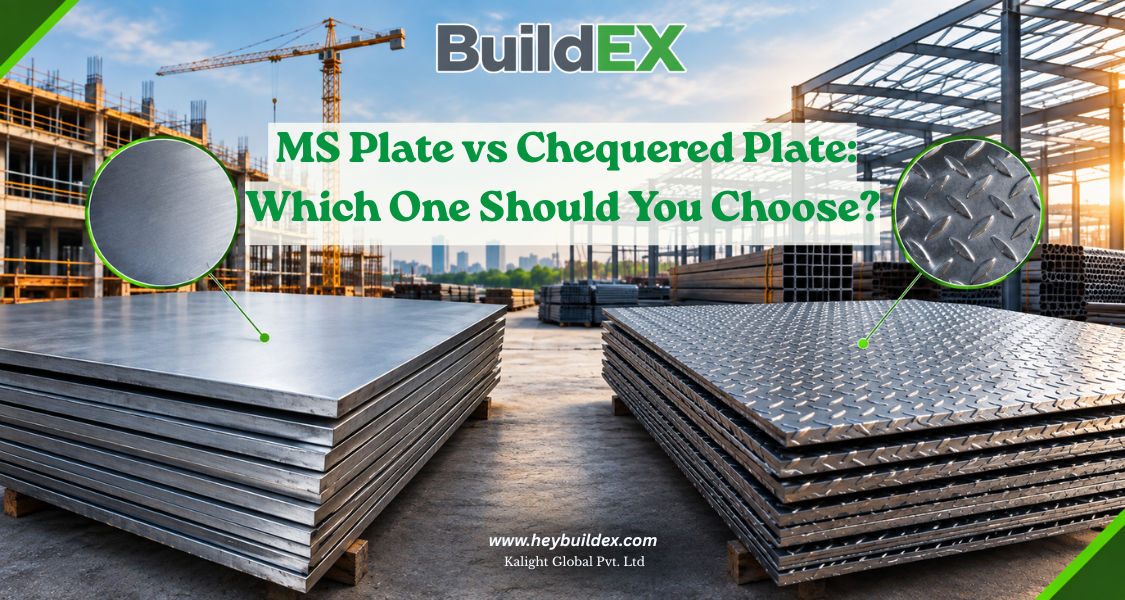
The main difference between an MS plate and a chequered plate is the surface pattern. A plain MS plate has a relatively flat surface, while a chequered plate has a raised pattern designed to provide improved foot traction in applications such as industrial flooring, platforms, walkways and ramps.
Choosing correctly depends on the application, the surface requirement, the load the plate will carry, its thickness, dimensions, fabrication needs and the specifications set out for the project.
What Is an MS Plate?
MS stands for mild steel, one of the most widely used structural materials in construction and fabrication. An MS plate, often called a plain steel plate, is a flat sheet of mild steel with a relatively smooth, unpatterned surface. It is manufactured in a range of thicknesses and dimensions to suit different structural and industrial requirements.
Because of its flat surface, an MS plate is easy to cut, weld, drill and shape, which makes it a common choice for fabricators building frames, panels, base plates and other structural components. Thickness can range from a few millimetres for light fabrication work to much heavier gauges for structural and load-bearing applications. The exact thickness and dimensions required depend on the load the plate needs to carry, the fabrication method used, and the applicable steel specification.
What Is a Chequered Plate?
A chequered plate is a mild steel plate with a raised, repeating pattern rolled into one surface during manufacturing. This raised design, commonly seen as diamond, lentil or raised-bar patterns, is why chequered plates are also referred to as tread plates or checker plates in different regions and industries.
The pattern exists mainly to improve foot traction. In wet, oily or dusty conditions, a patterned surface reduces the risk of slipping compared with a completely flat surface, which is why chequered plates are widely specified for flooring, walkways, platforms and similar traction-sensitive areas. The raised pattern does not automatically make the plate structurally stronger than a plain MS plate of the same base material and thickness — its value comes from the surface characteristics rather than any inherent strength advantage.
MS Plate vs Chequered Plate Difference
The table below summarises the practical MS plate vs chequered plate difference that most buyers and fabricators need to know before making a decision.
| Feature | MS Plate | Chequered Plate |
|---|---|---|
| Surface | Relatively plain and flat | Raised, patterned surface |
| Main purpose | Fabrication and structural applications | Flooring and traction-oriented applications |
| Surface grip | Depends on surface condition and coating | Raised pattern provides improved traction |
| Common applications | Fabrication, structures, panels | Platforms, walkways, ramps, flooring |
| Appearance | Smooth and flat | Patterned |
| Fabrication | Can be cut, welded and fabricated as specified | Can also be cut and fabricated as specified |
| Selection basis | Structural and application requirements | Application and surface requirements |
In short, a plain MS plate vs chequered plate comparison usually comes down to one question: does the surface need to be flat for fabrication, or patterned for traction? Both are mild steel products and both can be cut and welded to specification — the deciding factor is the intended application.
MS Plate vs Chequered Plate Uses
Understanding MS plate vs chequered plate uses helps buyers avoid ordering the wrong product for a project. The two are not interchangeable for every application, even though both are mild steel.
MS Plate Uses
Typical MS plate uses include:
- Structural fabrication, including frames and supports
- Equipment fabrication for industrial machinery
- Manufacturing of industrial components
- Base plates for columns and equipment
- Flat panels and covers
- Tanks or fabricated assemblies where a plain surface is required
- General construction-related fabrication work
Chequered Plate Uses
Typical chequered plate uses include:
- Industrial flooring in selected traffic areas
- Walkways where foot traffic needs a grip surface
- Access and maintenance platforms
- Stair treads and landings
- Ramps where surface grip is important
- Truck or trailer floors where specified
- Industrial access areas around machinery and plant
MS Plate Applications in Construction
MS plate applications in construction generally revolve around fabrication rather than flooring. Because the surface is flat, it fits well into assemblies that need to be welded, bolted or joined cleanly.
- Structural fabrication for frames, brackets and supports
- Base and support components for machinery and columns
- Fabricated frames used in building and site works
- Cover plates for openings, ducts and access points
- Equipment supports and mounting plates
- Industrial construction assemblies built to project drawings
Exact suitability for a given structural role depends on engineering calculations and the project's specifications, not on the plate type alone.
Chequered Plate Applications in Construction
Chequered plate applications in construction are concentrated in areas where a patterned surface offers a practical safety or functional benefit.
Walkways
Chequered plate is useful for walkways where foot traffic requires improved surface traction, particularly in areas exposed to moisture, dust or oil.
Staircases
Chequered plate can be used for stair treads and landing surfaces where the project specification calls for a patterned steel surface.
Platforms
It is well suited to industrial maintenance and access platforms, where consistent grip underfoot supports safer movement around equipment.
Ramps
On ramps, where the angle of the surface already increases slip risk, a patterned steel surface is often useful for maintaining traction.
Industrial Flooring
Chequered plate can be used in selected areas where a patterned steel surface is appropriate, though it is not suitable for every flooring application — the surrounding surface, load and usage pattern still need to be assessed.
Plain MS Plate vs Chequered Plate — Which Should You Choose?
Neither option is universally better. The right choice for a plain MS plate vs chequered plate comparison depends on what the plate is being used for.
Choose an MS plate when:
- A relatively flat surface is required for the application
- Fabrication is the primary objective
- The project specification calls for a plain steel plate
- Surface traction is not the main consideration
Consider a chequered plate when:
- Improved foot traction is important for safety
- The plate will be used for a walkway
- The application involves a platform
- A ramp or stair tread requires a patterned steel surface
- Industrial flooring in that specific area requires this type of plate
The right choice depends on the application rather than one plate being universally better than the other.
MS Plate vs Chequered Plate for Construction and Industry
As a general reference, the table below indicates which option is typically more relevant for common construction and industrial applications.
| Application | More Relevant Option |
|---|---|
| General steel fabrication | MS Plate |
| Structural fabrication | MS Plate |
| Flat panels | MS Plate |
| Industrial walkway | Chequered Plate |
| Stair tread | Chequered Plate |
| Access platform | Chequered Plate |
| Ramp surface | Chequered Plate |
| General-purpose fabrication | MS Plate |
| Traction-oriented flooring | Chequered Plate |
As a general reference, the table below indicates which option is typically more relevant for common construction and industrial applications.
This table indicates the more relevant option for common scenarios; it is not a universal engineering rule, and final selection should always be verified against project drawings and specifications.
How to Select the Right Steel Plate
Use the following step-by-step approach when comparing MS plates and chequered plates for a project.
- Identify the application — fabrication, structure, flooring, walkway, platform, ramp or staircase.
- Decide the surface requirement — whether a plain or patterned surface is appropriate for that use.
- Check plate thickness — select thickness according to project requirements rather than choosing based only on price.
- Check dimensions — verify length, width, thickness and weight against the drawing or requirement.
- Check steel specification — confirm the applicable material specification for the project.
- Consider fabrication requirements — cutting, welding, drilling, bending and finishing needs.
- Compare supplier quotations — compare equivalent specifications rather than comparing prices across different plate types or thicknesses.
- Verify material quality — check product documentation and material condition where applicable.
MS Plate and Chequered Plate Price Factors
Steel prices move with market conditions, so this article does not quote fixed rates. Instead, here is what typically influences pricing so you can compare quotations meaningfully:
- Prevailing steel market conditions
- Plate thickness
- Dimensions and weight
- Order quantity
- Additional manufacturing requirements for patterned (chequered) plates
- Transportation and location
- Supplier pricing policies
- Applicable taxes
When comparing quotations, always compare the same thickness, dimensions and specification across suppliers rather than comparing a plain plate price against a chequered plate price, or comparing different thicknesses against each other.
Common Mistakes When Buying Steel Plates
- Choosing only based on price without checking specification
- Comparing quotations for different thicknesses
- Ignoring dimensions and how they affect total weight
- Confusing a plain plate with a chequered plate for the intended use
- Not clearly defining the application before ordering
- Ignoring weight, which affects both cost and handling
- Not checking material specifications against project requirements
- Not factoring in transportation to the site
- Buying without verifying supplier details and documentation
Buy MS Plates and Chequered Plates from BuildEX
BuildEX supplies MS plates and chequered plates for construction, fabrication and industrial requirements. Buyers can enquire based on the required plate type, thickness, dimensions, quantity, application and delivery location.
Comparing equivalent specifications before placing a bulk order can help buyers select a product that matches their application and project requirements. This applies whether the requirement is for a fabrication project or for flooring, walkways or platforms that call for a patterned surface. For buyers sourcing steel for projects in locations such as Visakhapatnam, Vijayawada, Amaravati, Guntur, Kakinada, Nellore or elsewhere in Andhra Pradesh and Hyderabad, checking thickness, dimensions and specification against the intended application remains the most reliable way to make the right selection.
Frequently Asked Questions
1. What is the difference between an MS plate and a chequered plate?
The main difference is the surface. An MS plate has a relatively flat, plain surface, while a chequered plate has a raised pattern rolled into one side. The MS plate is typically chosen for fabrication and structural work, while the chequered plate is chosen where surface traction, such as on walkways or platforms, is the priority.
2. What are MS plates commonly used for?
MS plates are commonly used for structural fabrication, equipment fabrication, base plates, cover plates and flat panels. Their plain, flat surface makes them easy to cut, weld and shape, which is why fabricators use them for frames, supports and other structural or industrial components.
3. What are chequered plates commonly used for?
Chequered plates are commonly used for industrial flooring, walkways, access platforms, stair treads and ramps. The raised pattern on the surface improves foot traction, which is useful in areas where moisture, dust or oil could otherwise make a flat steel surface slippery.
4. Is a chequered plate stronger than a plain MS plate?
Not necessarily. A chequered plate is not automatically stronger than a plain MS plate of the same base material and thickness. The raised pattern is designed to improve surface traction, not to add structural strength. Strength depends primarily on the steel grade and plate thickness, not the surface pattern.
5. Why are chequered plates used for industrial flooring?
Chequered plates are used for industrial flooring because the raised surface pattern helps reduce slipping in areas with foot traffic, especially where the floor may get wet, oily or dusty. This makes them a practical choice for selected flooring areas where traction is a safety priority.
6. Can chequered plates be used for stair treads?
Yes, chequered plates can be used for stair treads and landing surfaces where the project specification calls for a patterned steel surface. The raised pattern helps improve grip underfoot on each step, which is useful in industrial and access staircases.
7. What is a checker plate?
A checker plate is the same product as a chequered plate — a mild steel plate with a raised, repeating pattern rolled into its surface. The terms checker plate, chequered plate and tread plate are used interchangeably across different regions and industries.