
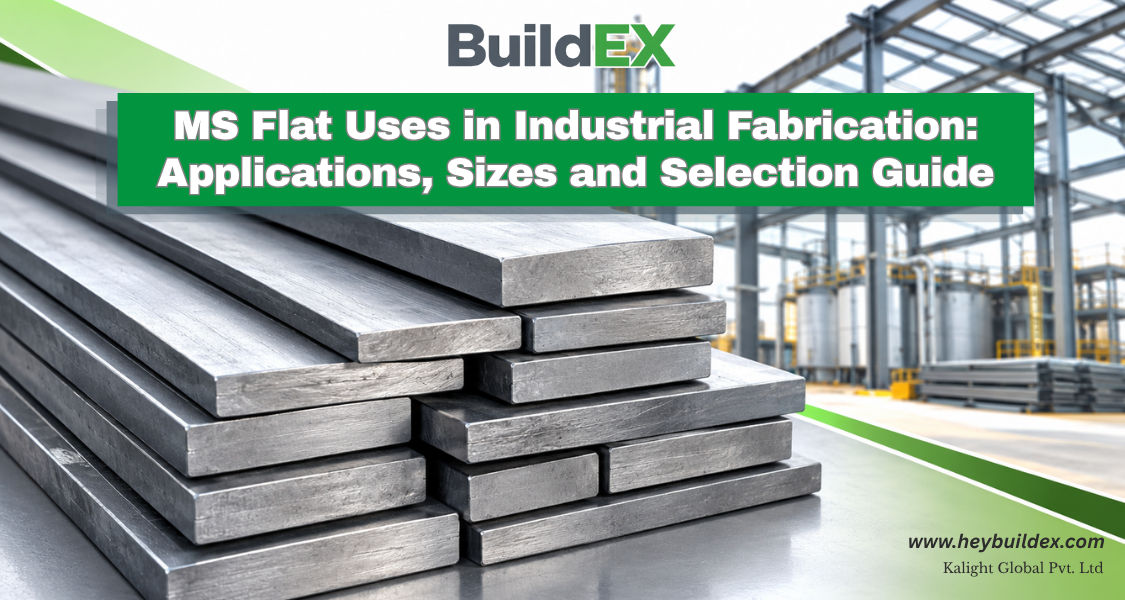
MS flat uses in industrial fabrication cover everything from small brackets to heavy equipment frames. A mild steel (MS) flat bar is a rectangular steel section that is easy to cut, weld, drill and bend, which makes it one of the most common materials in Indian workshops and construction sites. It balances adequate strength, low cost and good workability.
This guide explains where MS flats are used, which sizes fabricators commonly work with, how to calculate weight, and how to select the right bar and supplier. Use it as a practical reference, and confirm final dimensions with your design engineer.
What Is an MS Flat Bar?
An MS flat bar is a mild steel section with a rectangular cross-section, defined by its width, thickness and length. It is usually supplied in standard lengths and is produced mainly by hot rolling.
Unlike a steel plate, which is wider and sold by sheet dimensions, a flat bar is narrow and sold in strip-like sections. A round bar has a circular profile, and an angle section is bent into an L-shape for stiffness. A flat bar is the right choice when you need a straight, easy-to-cut strip for brackets, straps, frames or base supports.
Mild steel is popular because of its low carbon content, which gives good weldability and ductility at an economical cost. Always confirm the grade and standard with your supplier.
Major MS Flat Uses in Industrial Fabrication
Applications vary with load, environment, fabrication process and design specifications.
Structural Frames and Support Structures
Fabricators use MS flat bars for brackets, stiffeners, cross-bracing, base straps and light-to-medium frames. They are also used for reinforcement components where a simple, weldable strip is needed.
Machinery and Equipment Manufacturing
Machine bases, mounting strips, guards, clamps and cover supports are commonly made from MS flats. Their uniform thickness makes drilling and bolting predictable.
Gates, Grills, Railings and Fabricated Products
Flats are widely used for gate frames, window grills, staircase railings and decorative metalwork. They can be bent, scrolled and welded, then painted or galvanised for finish and protection.
Industrial Platforms, Walkways and Brackets
Flats serve as support brackets, edge strips, toe guards and connecting members in platforms and walkways. Any load-carrying element must follow the structural design.
Automotive, Agricultural and Engineering Applications
Trailers, implements, chassis accessories and general engineering parts often use flats, provided the specified grade and dimensions meet the design requirement.
Common MS Flat Sizes Used in Fabrication
Width, thickness and length determine strength, stiffness, weight and cost. Width and thickness are normally quoted together, for example 50 mm × 6 mm.
The table below shows illustrative examples only. It is not a market stock list or an engineering recommendation. Availability varies by supplier, specification and stock.
Width |
Thickness |
Typical application |
Approx. weight (kg/m) |
|---|---|---|---|
20 mm | 3 mm | Light brackets and small fabricated items | 0.47 |
25 mm | 5 mm | General-purpose supports and frames | 0.98 |
40 mm | 6 mm | Medium-duty fabrication | 1.88 |
50 mm | 8 mm | Frames and structural components, subject to design | 3.14 |
75 mm | 10 mm | Heavy-duty supports, subject to engineering checks | 5.89 |
The correct size depends on load, design, cutting requirements and intended use. Choosing a bar that is too thin risks deflection, while oversizing adds avoidable weight and cost.
MS Flat Weight Chart and Weight Calculation
Weight matters for estimating, transport, procurement and costing, since steel is commonly priced per kg. To estimate it, use this formula. For more size examples and calculated weights, see the MS flat sizes and weight chart.
Weight per metre (kg/m) = Width (mm) × Thickness (mm) × 0.00785
The formula assumes a steel density of approximately 7,850 kg/m³.
Example: For a 50 mm × 6 mm flat bar: 50 × 6 × 0.00785 = 2.355 kg/m.
For a standard 6-metre length, that is about 14.13 kg per bar. For 20 bars, the total is about 282.6 kg.
Total weight = weight per metre × length per bar × number of bars
Actual weight can vary slightly because of dimensional tolerances, so treat calculated figures as estimates and reconcile them with the supplier's billing weight.
How to Select the Right MS Flat Bar for Fabrication
An MS flat bar selection guide should start with the job itself. Work through these points:
- Application and load: Identify whether the part is decorative, supportive or load-bearing.
- Width, thickness and length: Match dimensions to design drawings and minimise cutting waste.
- Grade and standards: Confirm the material grade and applicable Indian Standard with your supplier.
- Processing needs: Consider welding, drilling, bending and cutting requirements.
- Exposure: Outdoor or humid conditions call for painting, galvanising or other corrosion protection.
- Tolerances and documentation: Check dimensional tolerances and ask for quality documents where required.
- Supplier and total cost: Weigh reliability, delivery timelines and total procurement cost, not just the rate.
Load-bearing components must be sized and approved by a qualified engineer. This article is general guidance, not a design recommendation.
Factors Affecting MS Flat Price Per Kg
The MS flat price per kg changes with several factors:
- Steel market movements and raw material costs.
- Size and grade: width, thickness, length and material grade.
- Order quantity: bulk procurement may be priced differently from small lots.
- Source and documentation: mill or brand, quality requirements and test paperwork.
- Logistics and taxes: transport, delivery distance, taxes and other applicable charges.
Because prices move frequently, request a current quotation based on your exact specifications and delivery location rather than relying on old figures.
Choosing MS Flat Suppliers in India
When comparing MS flat suppliers in India, evaluate:
- Availability and consistency: can they supply the required dimensions reliably?
- Transparent quotations: clear rates and weight calculations.
- Traceability: material documentation where applicable.
- Delivery capability: order quantities, delivery coverage and dispatch coordination.
- Service: communication, fulfilment reliability and after-sales support.
When sourcing in coastal or central Andhra Pradesh, compare suppliers in Visakhapatnam or Vijayawada using the checklist above. Confirm product availability and delivery coverage directly; proximity alone does not establish either.
Finding MS Flat Suppliers in Kurmannapalem and Anandapuram, Visakhapatnam
Industrial buyers, fabricators, contractors and construction businesses around Kurmannapalem and Anandapuram should confirm MS flat availability, dimensions, current pricing and delivery arrangements directly with a prospective supplier. BuildEX is a steel supplier, not a steel manufacturer. Availability and delivery coverage for a specific location should be confirmed before placing an order.
To request a quotation, visit https://www.heybuildex.com/ or contact the BuildEX team with your sizes, quantities and delivery location.
Conclusion
MS flat bars are a versatile and economical choice for industrial fabrication, with applications ranging from machinery to gates and structural supports. Choosing the right dimensions, estimating weight accurately and checking specifications can help ensure the material suits your project. When you are ready to source MS flats, BuildEX can help with enquiries and quotations based on your requirements.
Frequently Asked Questions About MS Flat Bars
What are the main MS flat uses in industrial fabrication?
MS flats are used for brackets, frames, machine bases, guards, gates, grills, railings, platform supports and engineering components. Their weldability and easy cutting suit both light and medium-duty work, with heavier uses subject to engineering design.
What are the common MS flat sizes available in India?
Common sizes range from narrow, thin strips such as 20 × 3 mm to wider, thicker sections such as 75 × 10 mm and beyond. Availability varies by supplier and stock, so confirm sizes before ordering.
How do you calculate the weight of an MS flat bar?
Multiply width (mm) by thickness (mm) by 0.00785 to get kg per metre. A 50 × 6 mm flat gives 2.355 kg/m. Multiply by length and quantity for total weight. Actual weight may vary slightly.
What is the difference between an MS flat and an MS flat bar?
In everyday trade, there is no practical difference; both mean a rectangular mild steel strip. "Flat bar" is the fuller technical term, while "MS flat" is the common market shorthand.
Which MS flat bar is suitable for heavy-duty fabrication?
Thicker, wider sections such as 75 × 10 mm are often used, but suitability depends on load, span and design. Have a qualified engineer specify the size and grade for load-bearing applications.
What factors affect the MS flat price per kg?
Prices depend on steel market movements, size, grade, order quantity, mill source, documentation, transport and taxes. Request a current quotation with your exact specifications and delivery location.
How can I find MS flat suppliers in Visakhapatnam or Vijayawada?
Search for local steel suppliers, compare availability, quotations and delivery support, and ask for weight calculations.