
- What Is an MS Angle?
- Why Are MS Angles Used in Industrial Sheds?
- MS Angle Applications in Industrial Sheds
- MS Angle for Warehouse Structures
- Equal Angle vs Unequal Angle for Shed Construction
- How to Choose MS Angle for Shed Construction
- MS Angle Size for Industrial Shed — What Should You Consider?
- IS 2062, E250 and E350 — What Do They Mean?
- MS Angle vs Other Structural Steel Sections
- Key Factors That Affect MS Angle Selection and Cost
- Common Mistakes When Buying MS Angles for Sheds
- Where to Buy MS Angles for Industrial Sheds?
- MS Angle for Industrial Sheds — Key Takeaways
- FAQ Section
An MS angle is an L-shaped mild steel section used in fabrication, framing, bracing and truss work for industrial sheds and warehouses. It provides a rigid, weldable, cost-effective member for trusses, bracing and secondary framework. Because loads, spans and connection details vary by project, the correct MS angle size and specification should always be confirmed against the structural design.
What Is an MS Angle?
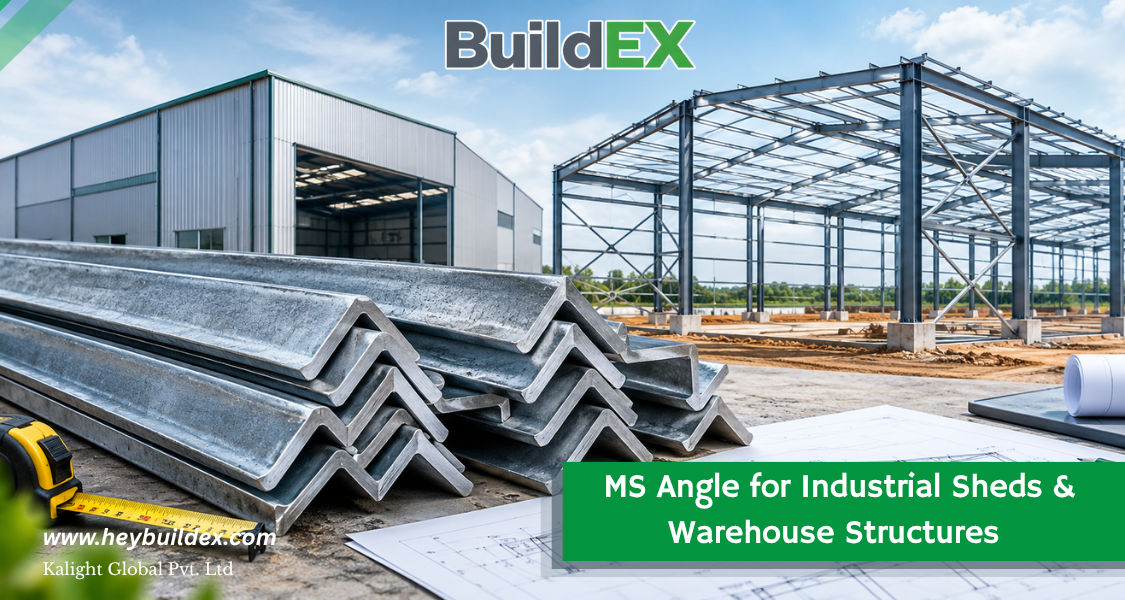
An MS angle, short for mild steel angle, is a structural steel section with an L-shaped cross-section formed by two legs joined at a right angle. It is also referred to as an angle section or structural angle, and is one of the most widely fabricated sections in the construction and engineering industry.
MS angles are broadly classified as equal angle or unequal angle. An equal angle has two legs of the same width, giving a symmetrical cross-section, while an unequal angle has legs of different widths, which can be useful where the structural design calls for a particular orientation or load path. Each angle is defined by its leg width, thickness and length, and these dimensions determine how the section behaves as part of a fabricated steel structure.
In practical terms, an MS angle is a building block. On its own it is simply a rolled section; its real value comes from how it is incorporated into a truss, a bracing system or a supporting framework as part of an engineered design.
Quick Answer: An MS angle is an L-shaped structural steel section used in fabrication, framing, bracing, trusses, supports and other construction applications. In industrial sheds, its suitability depends on the structural design, load requirements, dimensions, material specification and applicable standards.
Why Are MS Angles Used in Industrial Sheds?
MS angle for industrial sheds is a common choice because the section offers a practical balance of strength, weldability and fabrication flexibility. Typical reasons project teams specify MS angles include:
- Structural framing for trusses and supporting members
- Diagonal and cross bracing for stability
- Roof truss fabrication where the design calls for angle sections
- Support brackets, cleats and secondary structural connections
- Gusset and connection detailing between larger members
- Fabrication flexibility, since angles can be cut, drilled and welded where the design permits
- Wide availability across standard dimensions and thicknesses
None of this replaces the need for a qualified structural design; the angle is selected to suit the load path the engineer has defined, not the other way around.
MS Angle Applications in Industrial Sheds
MS angle applications in industrial sheds generally fall into a handful of recurring categories, summarised below.
Roof Trusses
MS angle for industrial roof trusses is one of the most recognised uses of the section. Depending on the structural design, angle sections can be fabricated into truss members that act in tension or compression, transferring roof loads down to the columns. The size, thickness and connection detail of each member depend on the span, spacing and load calculations prepared by the structural engineer — angles are not interchangeably assigned to a truss without this design step.
Shed Bracing
MS angle for shed bracing covers diagonal and cross-bracing systems that keep a shed's frame stable under lateral forces such as wind. Bracing angles resist sway and help transfer wind loads safely into the foundation. The bracing pattern, angle size and connection design are governed by the wind-load calculations and overall stability requirements of the structure, not by a single standard configuration.
Roof Framework
MS angle for industrial shed roof framework generally sits within a broader hierarchy: roof sheeting is supported by purlins, purlins rest on trusses, trusses are stabilised by bracing, and the whole assembly is carried by the supporting columns. MS angles are commonly used within the truss and bracing portions of this system; they are not automatically the purlins themselves, since purlins are frequently formed sections chosen for their own bending characteristics.
Warehouse Framework
MS angle for warehouse framework covers structural framing, bracing systems, support assemblies, fabricated brackets and connection plates used across warehouse steel structures. As with sheds, the specific role of each angle — whether as a primary framing member or a secondary support — is set by the engineering drawings for that warehouse.
Factory Shed Structures
MS angle for factory shed applications extends to manufacturing sheds, storage buildings, workshops, industrial facilities and utility structures. Across these building types, angles typically serve as fabricated bracing, truss members and secondary supports rather than as the main load-bearing columns.
MS Angle for Warehouse Structures
MS angle for warehouse structures deserves its own explanation because warehouses often combine long clear spans with heavier roof and equipment loads than a typical shed. Within a warehouse steel structure, angle sections may be incorporated into:
- Roof truss assemblies spanning between main frames
- Bracing systems that provide lateral and longitudinal stability
- Fabricated supports for walkways, mezzanines or equipment platforms
- Secondary structural components such as cleats, brackets and stiffeners
- Connection detailing between primary beams, columns and secondary members
Where are MS angles commonly used in warehouse construction? Most commonly within the truss and bracing systems and at secondary connections, with the primary framing typically handled by beams or built-up sections as specified in the structural drawings.
Equal Angle vs Unequal Angle for Shed Construction
| Feature | Equal Angle | Unequal Angle |
|---|---|---|
| Leg dimensions | Equal | Unequal |
| Cross-section | L-shaped | L-shaped |
| Common consideration | Symmetrical geometry | Different leg dimensions |
| Application | Depends on structural design | Depends on structural design |
| Selection | Based on engineering requirements | Based on engineering requirements |
How to Choose MS Angle for Shed Construction
Choosing the right MS angle for shed construction involves several interlinked factors.
Structural Load
The loads specified by the structural design — dead load, live load, wind load and any equipment load — determine the demand each angle member must carry.
Span and Configuration
The required section size depends on the span between supports, the truss or bracing configuration, and how loads are distributed across the structural system.
Angle Dimensions
Leg width, thickness, and length together define the section's capacity and its suitability for a given member. These dimensions are read directly off the structural drawings and the applicable section tables.
Equal or Unequal Angle
Where a connection or load path favours a particular leg orientation, an unequal angle may be specified; where geometry is symmetrical, an equal angle is typically used. This decision follows from the design, not from convenience.
Material Grade
Applicable steel grades and specifications should be confirmed for each order. Not every MS angle automatically meets a specific grade — the grade must be verified through the supplier's documentation and test certificates.
Applicable Standards
Two standards are frequently referenced together, though they serve different purposes:
- IS 2062 relates to hot-rolled medium and high tensile structural steel requirements — essentially the material specification.
- IS 808 relates to dimensions and sectional properties of hot-rolled steel beam, column, channel and angle sections — essentially the geometry, not a material grade.
Confirming both the material standard and the dimensional standard helps ensure the angle supplied matches what the structural design intended.
Fabrication and Connections
Welding, bolting, gusset plates, connection detailing and fabrication tolerances all affect how an angle performs once installed. Actual connection design should follow the project's engineering requirements rather than a generic assumption.
Environmental Conditions
Moisture, corrosion exposure, industrial atmosphere and any protective coating requirements should be factored into material selection and finishing, particularly for sheds and warehouses in humid or coastal environments.
MS Angle Size for Industrial Shed — What Should You Consider?
There is no universal MS angle size for every industrial shed. The required section depends on a combination of factors, including:
- Shed dimensions and overall footprint
- Span between structural supports
- Roof configuration and slope
- Design loads, including dead, live and equipment loads
- Wind conditions applicable to the site
- The specific function of the member — truss, bracing or support
- Connection details at each joint
- Steel grade used in the design
- The overall structural design prepared for the project
Buyer tip: The correct MS angle size should be selected from the structural design rather than choosing a section only because it is commonly used in another shed.
IS 2062, E250 and E350 — What Do They Mean?
IS 2062 is the Indian Standard covering hot-rolled medium and high tensile structural steel, specifying chemical composition and mechanical property requirements, including grades such as E250 and E350. The 'E' designation followed by a number broadly indicates the minimum yield strength in MPa — for example, E250 indicates a minimum yield strength around 250 MPa, while E350 indicates a higher minimum yield strength around 350 MPa.
A higher yield-strength grade is not automatically 'better' for every application — E350 is not universally superior to E250. The appropriate grade depends on the structural design, the specified material properties, member sizing and how the engineer has balanced strength against other design considerations. Selecting a grade without reference to the design can result in either an over-specified or under-specified member.
- Before purchase, buyers should verify:
- Material grade as specified in the design
- Test certificate confirming chemical and mechanical properties
- Dimensions matching the structural drawings
- Applicable standard (material and dimensional)
- Quantity against the bill of materials
- Supplier documentation and traceability
MS Angle vs Other Structural Steel Sections
| Section | Common Structural Role |
|---|---|
| MS Angle | Bracing, truss and fabricated members, supports |
| MS Channel | Frames, supports, secondary structural applications |
| MS Beam | Primary load-bearing applications |
| MS Plate | Connections, base plates, fabrication and structural components |
| MS Pipe | Tubular structural or fabricated applications |
Key Factors That Affect MS Angle Selection and Cost
- Section dimensions (leg width and length)
- Thickness of the angle
- Steel grade specified
- Order quantity
- Prevailing market steel price
- Manufacturing source and mill origin
- Delivery location and transportation distance
- Cutting or fabrication requirements
- Applicable taxes and commercial terms
MS angle price can vary with market conditions, specification and order quantity, so buyers should request a current quotation rather than relying on historical figures.
Common Mistakes When Buying MS Angles for Sheds
- Choosing a section based only on price
- Ignoring the structural drawings when placing an order
- Not checking thickness and dimensions against the specification
- Confusing material grade with section dimensions
- Not verifying test certificates before accepting delivery
- Ignoring corrosion protection requirements for the site conditions
- Comparing suppliers without checking that specifications match
- Ordering the wrong quantity against the bill of materials
- Failing to confirm delivery requirements and timelines in advance
- Treating theoretical weight as identical to actual supplied weight
Where to Buy MS Angles for Industrial Sheds?
BuildEX supplies MS angles and other structural steel products for construction, fabrication, warehouse and industrial requirements. Buyers can enquire based on required dimensions, thickness, material specification, quantity, application and delivery location.
Before finalising an order, it is worth confirming the following with your supplier:
- Required size (leg width and length)
- Thickness
- Grade and specification
- Quantity
- Delivery location
- Required documentation, including test certificates
For industrial and warehouse projects in Andhra Pradesh and nearby markets, buyers should confirm the required MS angle dimensions, grade, quantity and delivery location before placing an order.
Visit BuildEX at https://www.heybuildex.com/ to enquire about MS angle availability and specifications.
For projects requiring other structural sections, explore MS Beams and MS Channels from BuildEX, or check the Steel Weight Calculator and current Steel Prices before finalising quantities. MS Plates, MS Flat Bars, MS Pipes and TMT Bars are also available for related fabrication and construction requirements.
MS Angle for Industrial Sheds — Key Takeaways
- MS angles are L-shaped structural sections, also called mild steel or structural angles.
- They can be used in trusses, bracing and fabricated frameworks within sheds and warehouses.
- Equal and unequal angles have different leg geometries suited to different connection needs.
- Section size should be based on structural design requirements, not on convenience or common practice elsewhere.
- Material grade and applicable standards (IS 2062 for material, IS 808 for dimensions) should be verified before purchase.
- IS 2062 and IS 808 serve different purposes and should not be confused with each other.
- Proper documentation, including test certificates, should be checked before accepting delivery.
FAQ Section
1. What are MS angles used for in industrial sheds?
MS angles are used in industrial sheds for truss members, bracing, supports and other fabricated steel framework. Their exact role — whether load-bearing or secondary — depends on the structural design, with connections detailed to suit the specific application and load path involved.
2. How are MS angles used in industrial sheds?
MS angles are typically fabricated into truss members, cut and welded or bolted for bracing, and connected as secondary supports within the shed framework. Fabrication follows the structural drawings, with connection detailing, gusset plates and tolerances defined by the design engineer.
3. What size MS angle is suitable for an industrial shed?
There is no single suitable size for every shed. The appropriate MS angle size depends on span, roof configuration, design loads, wind conditions, member function and connection details, all of which are determined through the structural design process rather than a generic standard size.
4. Which MS angle is used for shed bracing?
The MS angle used for shed bracing depends on the structural design, loading conditions, bracing geometry and connection requirements. Diagonal and cross-bracing members are sized individually based on the lateral loads, such as wind, that the shed frame needs to resist.
5. Can MS angles be used for industrial roof trusses?
Yes, MS angles can be incorporated into roof-truss systems where specified by the structural design. They commonly form tension and compression members within the truss, with the exact size and arrangement determined by span, spacing and load calculations.
6. What is the difference between equal and unequal MS angles?
An equal angle has two legs of the same width, giving a symmetrical L-shaped cross-section. An unequal angle has legs of different widths. Both are structural angle sections, but the choice between them depends on the connection geometry and structural design requirements.
7. How do I choose an MS angle for shed construction?
Choosing an MS angle involves checking dimensions, thickness, material grade, design loads, span, intended application, and applicable standards such as IS 2062 and IS 808\. The final selection should always follow the project's structural engineering requirements rather than assumptions.
8. What is IS 2062 in structural steel?
IS 2062 is the Indian Standard covering hot-rolled medium and high tensile structural steel, specifying chemical composition and mechanical property requirements for grades such as E250 and E350. It defines material specifications rather than section dimensions.