
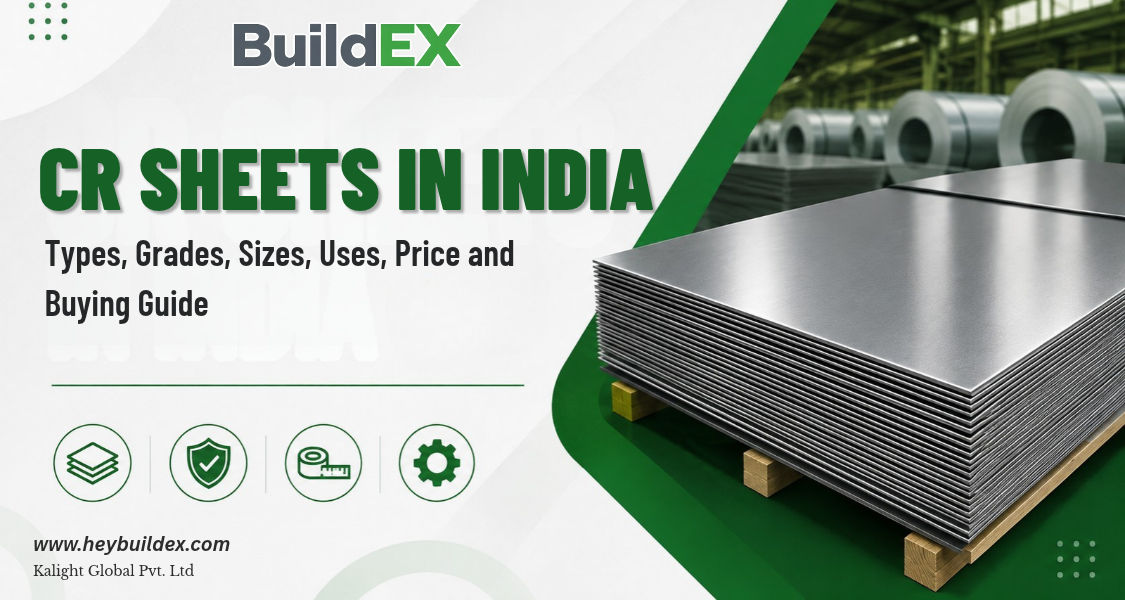
CR sheets in India are cold-rolled steel sheets: steel that has been rolled at room temperature after hot rolling and pickling. The process gives a smoother surface, closer thickness control and better formability than hot-rolled sheet. They are widely used for automotive parts, electrical panels, appliances, furniture and general fabrication. Before buying, confirm the grade, thickness, dimensions, tolerances, surface finish and delivery terms, because these decide both performance and price.
This guide explains CR sheet types, grades, sizes, thickness, weight, uses and pricing factors, so buyers, fabricators and procurement teams can write a clear enquiry and compare quotations properly.
What Are CR Sheets?
CR (cold-rolled) sheets start as hot-rolled coil. The coil is pickled to remove scale, then passed through rolling mills at room temperature to reduce thickness. The material is usually annealed afterwards to restore ductility, and may be skin-passed to control surface finish and flatness.
Typical characteristics include a smoother surface, tighter dimensional control and good suitability for forming and painting. Exact properties still depend on the grade, thickness, processing route and the specification the material is supplied to.
CR vs CRCA: CRCA stands for Cold Rolled Close Annealed. In Indian trade, "CR sheet" and "CRCA sheet" are often used interchangeably, but usage varies between suppliers. Always confirm the grade, annealing condition and standard in writing instead of relying on the name alone.
Types of CR Sheets Available in India
CR sheets are commonly grouped by forming quality. Availability varies by supplier and not every category is interchangeable.
- Commercial-quality sheets: Suited to general fabrication, light bending and simple formed parts such as enclosures and brackets.
- Drawing-quality sheets: Offer better formability for moderate drawing and pressing operations.
- Deep-drawing-quality sheets: Intended for more severe forming, such as deeper pressed components.
- High-strength cold-rolled grades: Used where higher strength is needed, often in automotive and structural sheet components. These are specialized and are not stocked by every supplier.
- CRCA sheets for fabrication: The most common commercial form for panels, cabinets, furniture and engineering parts.
CR Sheet Grades and Specifications
The right grade matters because bending, drawing, strength and surface quality requirements differ between applications. A grade that suits a flat panel may crack in a deep-drawn part.
In India, cold-reduced carbon steel sheet and strip are covered by the IS 513 series published by the Bureau of Indian Standards (BIS). Suppliers' catalogues may also show international designations, such as EN 10130 grades (DC01, DC03, DC04 and similar). These should not be treated as exact equivalents unless the specification or test certificate confirms it.
Grade or category |
General characteristics |
Typical applications |
What buyers should verify |
Commercial quality |
General-purpose forming and bending |
Panels, brackets, enclosures |
Standard, grade, thickness tolerance |
Drawing quality |
Better formability for pressing |
Pressed and formed parts |
Grade, forming requirement, test certificate |
Deep-drawing quality |
Designed for severe forming |
Deep-drawn components |
Grade, annealing condition, surface finish |
High-strength cold-rolled |
Higher strength, specialised processing |
Automotive and structural sheet parts |
Specification, availability, certificate |
CRCA for fabrication |
Annealed, smooth, easy to paint |
Cabinets, furniture, appliances |
Naming basis, grade, surface quality |
Do not assume mechanical values or composition from the name. The purchase specification and the material test certificate (MTC) should define the actual requirements.
CR Sheet Sizes Available in India
CR sheet sizes vary by supplier, grade, thickness and order. Material is generally supplied as cut sheets or as coils for buyers who do their own cutting or slitting. Any size list should be treated as indicative, not as a universal standard, so confirm availability before ordering.
A clear enquiry should specify:
- Thickness
- Width and length
- Grade and applicable standard
- Sheet or coil format
- Surface finish
- Dimensional tolerances
CR Sheet Thickness Chart
The table lists illustrative thickness examples in millimeters. It is not a guarantee of stock availability and not a universal standard.
Thickness (mm) |
Typical use (indicative) |
0.5 | Light enclosures, thin panels |
0.8 | Appliance parts, light cabinets |
1.0 | Control panels, furniture parts |
1.2 | Panels, brackets |
1.5 | Electrical enclosures, stiffer panels |
2.0 | General fabrication, frames |
2.5 | Heavier brackets and supports |
3.0 | Light structural parts |
Thickness affects weight, stiffness, forming behaviour and cost. A thicker sheet is stiffer but harder to bend and costs more per piece. Confirm the available thickness range and tolerance with your supplier.
CR Sheet Weight Chart and Weight Calculation
For a rectangular carbon steel sheet, theoretical weight can be estimated as:
Weight (kg) = Length (m) × Width (m) × Thickness (mm) × 7.85
The value 7.85 is an approximate steel density factor. Actual supplied weight may differ because of thickness tolerances and material variations.
Worked example (hypothetical sheet): 2.5 m × 1.25 m × 1.5 mm
- Area = 2.5 × 1.25 = 3.125 m²
- Weight = 3.125 × 1.5 × 7.85 = about 36.80 kg
The table below shows theoretical weights for the same hypothetical 2.5 m × 1.25 m sheet (3.125 m²).
Thickness (mm) |
Weight per m² (kg) |
Weight per 2.5 m × 1.25 m sheet (kg) |
0.5 | 3.93 | 12.27 |
0.8 | 6.28 | 19.63 |
1.0 | 7.85 | 24.53 |
1.2 | 9.42 | 29.44 |
1.5 | 11.78 | 36.80 |
2.0 | 15.70 | 49.06 |
2.5 | 19.63 | 61.33 |
3.0 | 23.55 | 73.59 |
These are theoretical weights. They are not verified dispatch or weighbridge weights, so confirm the billing basis with the supplier.
CR Sheet Uses Across Industries
- Automotive: Formed and pressed parts, subject to grade and forming needs.
- Electrical: Cabinets, control panels and switchgear enclosures.
- Appliances and equipment: Housings and covers where a smooth, paintable surface is useful.
- Furniture and storage: Lockers, racks, shelving and office furniture.
- General engineering: Fabricated parts, frames and covers.
- Light sheet-metal work: Brackets, enclosures and small components.
Suitability depends on grade, thickness, forming requirements, corrosion protection and service conditions. Uncoated CR sheet can rust, so for humid, outdoor or corrosive environments it needs suitable protection such as painting, powder coating or plating, or a coated material should be chosen instead.
CR Sheet vs HR Sheet: Key Differences
Factor |
CR sheet |
HR sheet |
Manufacturing process |
Rolled at room temperature after hot rolling and pickling |
Rolled at high temperature |
Surface appearance |
Generally smoother and cleaner |
Typically rougher, may carry scale |
Dimensional control |
Often tighter |
Wider tolerances are common |
Formability |
Often chosen for forming and pressing, depends on grade |
Suitable where its surface and tolerances are acceptable |
Common applications |
Panels, appliances, furniture, precision parts |
Structural, heavier fabrication, general work |
Relative cost |
Often higher per kg because of extra processing |
Often lower per kg, but varies |
Neither type is always stronger, better or cheaper. Performance and price depend on the grade, processing, dimensions and application.
CR Sheet Price Per Kg in India
CR sheet prices change with market conditions, so this article does not quote a price. A quotation can vary because of:
- Material grade and specification
- Thickness and dimensions
- Order quantity
- Surface quality and finishing requirements
- Market conditions and the date of the quotation
- Freight, taxes, packaging and delivery location
When asking for a quote, request the date, unit, grade, whether GST and delivery are included, and the weight basis. Compare quotations on the same grade, dimensions, tolerances, quantity and delivery terms, not on price per kg alone.
How to Choose a Reliable CR Sheet Supplier in India
Use this checklist:
- Grade and specification confirmed in writing
- Requested dimensions available
- Material test certificates and traceability, where applicable
- Surface condition and tolerances agreed
- Transparent weight and billing details
- Order quantity and lead time clear
- Delivery location and freight terms stated
- Written quotation and responsive after-sales communication
BuildEX is a steel and metal supply partner, not a steel manufacturer. Buyers can send their grade, size and quantity requirements for review, and availability is confirmed at enquiry. To discuss your requirement, visit BuildEX and enquire about steel products and supply.
Common Mistakes to Avoid When Buying CR Sheets
- Choosing a grade on price alone
- Ignoring thickness tolerances
- Confusing CR and HR material
- Overlooking surface requirements
- Treating theoretical weight as billed weight without checking the agreed basis
- Not confirming delivery costs
Frequently Asked Questions About CR Sheets
What are CR sheets used for?
CR sheets are used for automotive parts, electrical cabinets, appliance housings, furniture and general fabrication. They suit applications needing a smooth surface, close thickness control and good formability. Suitability depends on grade, thickness and corrosion protection.
What is the difference between CR and CRCA sheets?
CR means cold-rolled. CRCA means cold rolled close annealed, i.e. cold-rolled steel that has been annealed. In the Indian market the terms are often used interchangeably, but usage varies, so confirm grade and condition in writing.
What are the common CR sheet grades in India?
Grades are usually grouped by forming quality: commercial, drawing, deep-drawing and high-strength. Designations follow the IS 513 series or international catalogue names. Check the applicable standard and test certificate before ordering.
What CR sheet sizes are available in India?
Sizes vary by supplier, grade and thickness. Material is supplied as cut sheets or coils. There is no single universal list, so share your required width, length and thickness and confirm availability with the supplier.
How is CR sheet weight calculated?
Multiply length (m) by width (m) by thickness (mm) by 7.85. For example, 2.5 m × 1.25 m × 1.5 mm gives about 36.80 kg. This is a theoretical estimate based on an approximate steel density, and supplied weight may differ because of tolerances. Confirm the billing basis with the supplier.
What factors affect CR sheet price per kg?
Price depends on grade, thickness, dimensions, quantity, surface requirements, market conditions on the quotation date, and freight, taxes and packaging. Ask for a dated written quotation and compare like for like.
Are CR sheets suitable for bending and fabrication?
Yes, CR sheets are widely used for bending and fabrication, but suitability varies by grade and thickness. Commercial grades suit simple bends; drawing grades suit more demanding forming. State your forming needs to the supplier.
What is the difference between CR sheets and HR sheets?
CR sheets are rolled at room temperature and generally have a smoother surface and tighter dimensional control. HR sheets are rolled hot and are often chosen where their surface and tolerances are acceptable. Neither is always better; it depends on the application.
How do I choose the right CR sheet thickness?
Choose based on required stiffness, load, forming method, weight and cost. Thicker sheet is stiffer but heavier and harder to form. Check your design needs and confirm the available range and tolerance with the supplier.